

Barbara Stanwyck: Her Life, Movies, and Lasting Legacy
 Caitlin Goddard
25 mins0
Caitlin Goddard
25 mins0
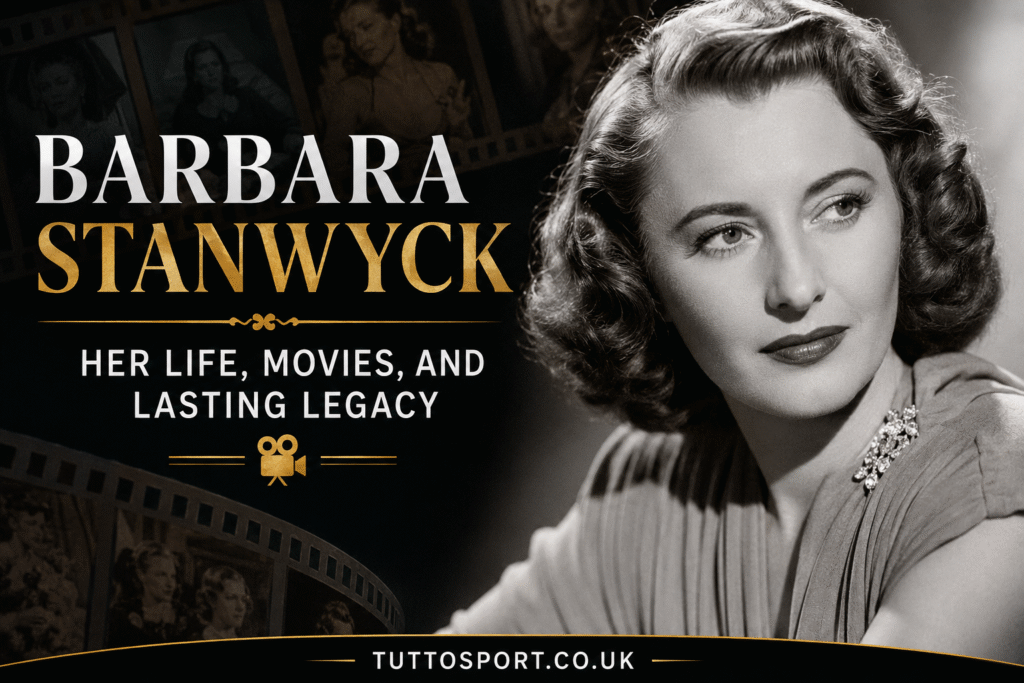
Barbara Stanwyck: Her Life, Movies, and Lasting Legacy
Few performers moved between comedy, drama, film noir, Westerns, and television as confidently as Barbara Stanwyck. She could play a devoted mother in one film, a clever con artist in another, and a dangerous murder conspirator in the next. Instead of depending on one glamorous screen image, she built her career around believable characters.
Born Ruby Catherine Stevens in Brooklyn in 1907, she experienced an unsettled childhood before finding work as a dancer and stage performer. Her determination eventually carried her from Broadway to Hollywood, where she became one of the most respected stars of American cinema. She received four competitive Academy Award nominations, three Primetime Emmy Awards, an Honorary Academy Award, and the American Film Institute’s Life Achievement Award.
Her story is not simply about fame. It is also about professional discipline, artistic range, and the ability to remain relevant as the entertainment industry changed around her.
Barbara Stanwyck Biography
The following table includes publicly verified biographical information. Her birth and death dates show that she was 82 years, six months, and four days old when she died.
| Biography detail | Verified information |
|---|---|
| Full professional name | Barbara Stanwyck |
| Birth name | Ruby Catherine Stevens |
| Date of birth | July 16, 1907 |
| Place of birth | Brooklyn, New York, United States |
| Date of death | January 20, 1990 |
| Age at death | 82 |
| Place of death | Santa Monica, California, United States |
| Nationality | American |
| Profession | Actress and dancer |
| Stage career began | During the 1920s |
| First husband | Frank Fay |
| Second husband | Robert Taylor |
| Children | One adopted son, Dion Anthony Fay |
| Competitive Oscar nominations | Four |
| Honorary Academy Award | Presented in 1982 |
| Primetime Emmy wins | Three |
| Net worth | Not publicly confirmed by an authoritative financial record |
A Difficult Childhood in Brooklyn
She was born into a working-class Brooklyn family as the youngest of five children. Her mother died when Ruby was four, and her father later left the family. She subsequently spent parts of her childhood living with relatives and in foster homes.
These early experiences have often been connected to the independence seen in many of her screen characters. However, it is important not to turn personal hardship into convenient psychological speculation. What can be established is that she began working at a young age and developed the determination needed to support herself.
As a teenager, she found work as a dancer in nightclubs, revues, and stage productions. The entertainment world offered a possible route away from financial uncertainty, but success did not arrive instantly. She had to move from chorus work into dramatic acting before producers began to see her as more than a dancer.
How Ruby Stevens Became Barbara Stanwyck
Her important stage breakthrough came with The Noose, a 1926 Broadway production in which she played a dramatic role. Around this period, Ruby Stevens adopted the professional name by which audiences would remember her.
She followed that appearance with a leading role in the Broadway production Burlesque in 1927. The play established her as a serious stage actress and attracted attention from the developing motion-picture business.
Her early experiences on stage helped shape an acting style that later appeared unusually direct on film. She did not rely heavily on grand gestures or a polished theatrical voice. Her delivery often sounded conversational, and her emotions appeared to come from the circumstances of a scene rather than from a visible attempt to impress the audience.
That quality became especially valuable as Hollywood moved from silent films into talking pictures.
Her Early Hollywood Breakthrough
Her first years in cinema were not immediately successful. She appeared in The Locked Door in 1929, but it was her work with director Frank Capra that brought wider recognition.
Capra cast her in Ladies of Leisure in 1930. The film allowed her to show emotional openness without losing the toughness that would become part of her screen identity. She later worked with Capra on additional films, including The Miracle Woman, The Bitter Tea of General Yen, and Meet John Doe.
During the early 1930s, she appeared in several films that challenged traditional ideas about female characters. In Night Nurse, she played a determined medical worker who uncovers criminal behaviour. In Baby Face, she portrayed an ambitious woman using the limited choices available to her to rise through the business world.
Baby Face became particularly associated with Hollywood’s pre-Code period, when filmmakers addressed sexuality, corruption, and social inequality more directly than they could after stricter production rules were enforced.
The Movies That Defined Her Career
Her filmography covered a remarkable range of genres. These movies provide a useful introduction to her work:
| Movie | Year | Why it remains important |
|---|---|---|
| Baby Face | 1933 | A bold pre-Code drama about ambition and power |
| Stella Dallas | 1937 | Earned her first Academy Award nomination |
| Union Pacific | 1939 | A major Cecil B. DeMille Western |
| Golden Boy | 1939 | Paired her with a young William Holden |
| Remember the Night | 1940 | Blended romance, comedy, and emotional drama |
| The Lady Eve | 1941 | Displayed her skill in sophisticated comedy |
| Meet John Doe | 1941 | Reunited her with director Frank Capra |
| Ball of Fire | 1941 | Earned her second Oscar nomination |
| Double Indemnity | 1944 | Became one of the defining films of film noir |
| The Strange Love of Martha Ivers | 1946 | Gave her a darker dramatic character |
| Sorry, Wrong Number | 1948 | Earned her fourth Oscar nomination |
| Clash by Night | 1952 | Showed her strength in mature domestic drama |
| All I Desire | 1953 | A restrained melodrama directed by Douglas Sirk |
| Forty Guns | 1957 | Cast her as a powerful Western landowner |
Her four competitive Academy Award nominations came for Stella Dallas, Ball of Fire, Double Indemnity, and Sorry, Wrong Number.
Why Stella Dallas Was a Career Landmark
In Stella Dallas, she played a working-class woman who wants her daughter to enter a more socially privileged world. The role could easily have become overly sentimental, but her performance balanced emotional intensity with restraint.
The film earned her first Academy Award nomination for Best Actress. It also demonstrated that she could make an imperfect character sympathetic without removing the qualities that made the character difficult or socially awkward.
Rather than presenting Stella as a simple symbol of motherhood, she played her as a complete person with pride, insecurity, humour, and genuine affection. That complexity is one reason the performance continues to be discussed.
Comedy in The Lady Eve and Ball of Fire
Although she is often associated with serious drama and film noir, she was also a highly skilled comic performer.
In Preston Sturges’s The Lady Eve, she played an experienced cardsharp who targets a wealthy but innocent traveller played by Henry Fonda. The character required confidence, precise timing, romantic charm, and the ability to shift between different identities.
Her performance never treated comedy as separate from character. The humour came from control, frustration, attraction, and the shifting balance of power between the central couple.
The same year, she starred opposite Gary Cooper in Howard Hawks’s Ball of Fire. She played nightclub performer Sugarpuss O’Shea, whose knowledge of modern slang attracts the attention of a group of sheltered academics. The role brought her another Academy Award nomination and further confirmed her ability to move naturally between comedy and drama.
Double Indemnity and Her Film-Noir Legacy
For many viewers, her most famous performance remains Phyllis Dietrichson in Billy Wilder’s Double Indemnity. The 1944 film follows an insurance salesman who becomes involved in a plan to murder Phyllis’s husband and collect the insurance payment.
The character is manipulative, controlled, and dangerous, but the performance is more than a simple portrayal of a villain. Small changes in her voice and expression suggest calculation, impatience, fear, and emotional distance.
Double Indemnity became one of the central works of American film noir. Her performance earned her third Academy Award nomination and showed that an established leading actress could take on a deeply unsympathetic character without trying to make the role conventionally likeable.
Four Oscar Nominations and an Honorary Award
Despite receiving four Best Actress nominations, she did not win a competitive Academy Award. That fact is sometimes presented as evidence that her career was overlooked, but awards alone provide an incomplete measure of her influence.
In March 1982, the Academy presented her with an Honorary Award recognising her creativity and contribution to screen acting. She received the ceremony’s only standing ovation, according to the Academy’s account of the event.
The honour acknowledged a career that had already influenced several generations of performers. It also recognised the unusual consistency of her work across major studios and genres.
Moving Successfully from Film to Television
The decline of the traditional studio system created difficulties for many established movie stars. She responded by treating television as a serious acting medium rather than as a lesser form of entertainment.
The Barbara Stanwyck Show aired in the early 1960s and brought her first Primetime Emmy Award in 1961. Although the anthology series had a limited run, the award demonstrated that her skills translated effectively to television.
Her greatest long-running television success came with The Big Valley, which aired from 1965 to 1969. She played Victoria Barkley, the widowed head of a wealthy ranching family. The character was firm, physically active, and involved in the family’s decisions rather than being reduced to a background maternal role.
She won an Emmy in 1966 for the series and received further nominations in later seasons.
In 1983, she won her third Emmy for the television miniseries The Thorn Birds. Late-career appearances in Dynasty and its spin-off The Colbys introduced her to another generation of viewers.
Confirmed Marriages and Family Life
She married twice. Her first husband was stage performer Frank Fay. They married in 1928 and divorced in 1935. During their marriage, they adopted a son, Dion Anthony Fay.
She later married actor Robert Taylor in 1939. Their divorce was completed in 1952. They were among Hollywood’s most visible couples, but she generally avoided discussing the private details of their relationship publicly. She did not marry again.
Her relationship with her adopted son became distant during his adult life. Because accounts of their family difficulties often come from biographies, interviews, or retrospective reports, the subject should be handled without sensationalism or attempts to diagnose either person’s private behaviour.
Rumours and Unconfirmed Claims
Over the years, unverified claims have circulated about her marriages, sexuality, private relationships, and the reasons behind her divorces. Much of this material relies on anonymous gossip, studio-era speculation, or interpretations offered long after the people involved had died.
Those claims should not be presented as established facts. Her two marriages are publicly documented, but allegations about secret arrangements or undisclosed relationships remain unconfirmed unless supported by reliable first-hand evidence.
Her career does not require gossip to make it interesting. The documented work already provides a far stronger and more responsible story.
Was Barbara Stanwyck Net Worth Confirmed?
No authoritative public financial record establishes a precise figure for her net worth at the time of her death. Celebrity-finance websites sometimes publish estimates, but these numbers may not account for taxes, property transfers, estate planning, private investments, or the changing value of assets.
Any number attached to her fortune should therefore be described only as an unverified estimate, not as a confirmed fact. The official biographical and awards records used to verify her career do not provide an authenticated net-worth figure. This is an inference from the available authoritative records rather than proof that no private documentation exists.
Major Awards and Career Recognition
Her achievements extended beyond her Oscar and Emmy recognition. She received the Cecil B. DeMille Award at the Golden Globes in 1986 and the American Film Institute’s Life Achievement Award in 1987.
In 1999, the American Film Institute placed her at No. 11 on its list of the greatest female screen legends from classic American cinema. The ranking reflected not only the popularity of her films but also her importance to the history of screen performance.
Her Death at the Age of 82
She died in Santa Monica, California, on January 20, 1990. She was 82 years old. Her longtime press agent told the Los Angeles Times that the cause was congestive heart failure.
Her death came after a professional life that had stretched from Broadway revues and early talking pictures to 1980s television drama. Few performers from her generation remained active across so many changes in production, storytelling, and audience taste.
Why Her Acting Still Feels Modern
The lasting appeal of Barbara Stanwyck comes partly from the absence of visible vanity in her performances. She was willing to appear frightened, selfish, exhausted, calculating, funny, ordinary, or emotionally exposed when a role required it.
Her characters frequently want something concrete: independence, money, security, love, social acceptance, or control. That clarity gives her performances energy. Even when a character makes a destructive decision, the audience can usually understand the pressure or desire behind it.
She also portrayed women who acted rather than merely reacted. They made plans, ran businesses, managed families, broke rules, survived danger, and faced the consequences of their choices. This was especially striking in an industry that often limited women to supporting the ambitions of male characters.
Frequently Asked Questions
What was Barbara Stanwyck’s real name?
Her birth name was Ruby Catherine Stevens. She adopted her professional stage name during the early part of her theatrical career.
When and where was she born?
She was born on July 16, 1907, in Brooklyn, New York.
How old was she when she died?
She was 82 years old. More precisely, she was 82 years, six months, and four days old when she died on January 20, 1990.
What is her most famous movie?
Double Indemnity is frequently regarded as her best-known film, particularly among film-noir audiences. Other essential titles include The Lady Eve, Stella Dallas, Ball of Fire, and Sorry, Wrong Number.
Did she ever win an Oscar?
She did not win a competitive Oscar despite receiving four Best Actress nominations. However, she received an Honorary Academy Award at the 54th Academy Awards ceremony in 1982.
How many Emmy Awards did she win?
She won three Primetime Emmy Awards: for The Barbara Stanwyck Show, The Big Valley, and The Thorn Birds.
Was she married?
Yes. She was married to Frank Fay and later to Robert Taylor. Both marriages ended in divorce, and she did not remarry.
Conclusion
Barbara Stanwyck earned her place in Hollywood history through versatility rather than a single signature role. She could lead a romantic comedy, carry an emotional melodrama, dominate a Western, or become the dangerous centre of a film noir.
Her four competitive Oscar nominations, Honorary Academy Award, three Emmy wins, Golden Globe career honour, and AFI recognition provide a formal record of her achievements. Yet the strongest evidence of her importance remains the work itself.
Films such as Stella Dallas, The Lady Eve, Ball of Fire, and Double Indemnity still reveal an actress who understood how to make complex emotions appear immediate. Her transition to The Big Valley and The Thorn Birds showed the same commitment decades later.
Her career lasted because she was never limited to glamour, genre, or one type of character. She built her legacy by making each role feel like a real person with something important at stake.