

Randy Johnson Bird Incident: 10 Facts Fans Should Know

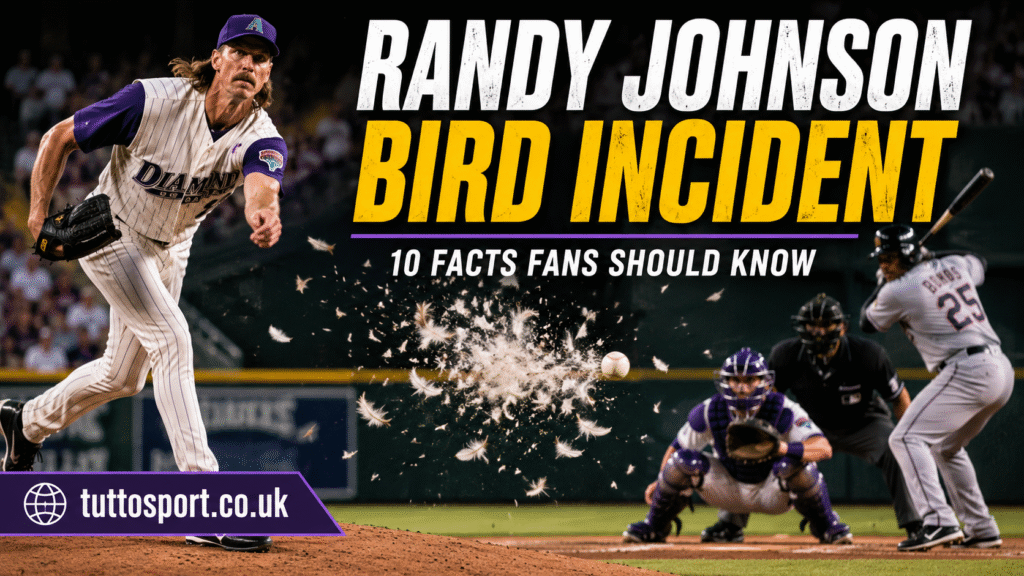
Randy Johnson Bird Incident: 10 Facts Fans Should Know
Some baseball moments are remembered because they decide a championship. Others live forever because nobody can quite believe what they just saw.
The Randy Johnson Bird Incident belongs firmly in the second group.
On March 24, 2001, Randy Johnson stood on the mound during an ordinary Spring Training game between the Arizona Diamondbacks and San Francisco Giants. He delivered one of his famous fastballs toward home plate. At that exact moment, a bird flew across the path of the pitch.
The result was sudden, shocking, and almost impossible to repeat.
A cloud of feathers appeared between the mound and the plate. The batter froze. The catcher stood up. Players, umpires, broadcasters, and spectators needed a moment to understand what had happened.
More than two decades later, the short video remains one of the strangest clips in Major League Baseball history. Even people who have never watched a full baseball game often recognize it.
However, there is more to the story than the famous footage. Where did it happen? Who was batting? Did the pitch count? How fast was the ball moving? And how did Randy Johnson respond?
Here are 10 important facts every fan should know about the Randy Johnson Bird Incident.
Randy Johnson Bio
Before examining the unusual pitch, it helps to understand the player who threw it. Randy Johnson was not an average pitcher having a lucky season. He was one of the most intimidating and successful pitchers baseball has ever seen.
| Bio Detail | Information |
|---|---|
| Full Name | Randall David Johnson |
| Nickname | The Big Unit |
| Date of Birth | September 10, 1963 |
| Age | 62 as of June 2026 |
| Birthplace | Walnut Creek, California, United States |
| Profession | Former professional baseball pitcher and photographer |
| Nationality | American |
| MLB Career | 1988–2009 |
| Position | Pitcher |
| Bats / Throws | Right / Left |
| Net Worth | No verified public figure; online estimates vary |
| Notable Achievements | 303 wins, 4,875 strikeouts, five Cy Young Awards, 10 All-Star selections, 2001 World Series champion and Hall of Fame inductee |
Johnson played 22 Major League seasons for six teams. Still, most fans associate him with the Seattle Mariners and Arizona Diamondbacks. His tall frame, side-arm delivery, powerful fastball, and devastating slider made him a nightmare for hitters.
At 6 feet 10 inches tall, he looked imposing before he even released the ball. Once the pitch left his hand, batters had only a fraction of a second to react.
1. The Incident Happened on March 24, 2001
The first key fact is the date. The Randy Johnson Bird Incident happened on March 24, 2001.
Johnson was pitching for the Arizona Diamondbacks in Tucson, Arizona. His team was facing the San Francisco Giants at Tucson Electric Park, which was Arizona’s Spring Training home at the time.
The event did not happen during a regular-season contest, playoff series, or World Series game. It took place during an exhibition matchup as both teams prepared for the approaching MLB season.
That detail matters because Spring Training games usually have a relaxed atmosphere. Teams use them to test lineups, evaluate players, and help pitchers build strength before Opening Day.
Nobody arrived at the stadium expecting to witness one of the most replayed moments in sports history.
A Normal Day Became Baseball History
For most of the afternoon, the game appeared completely ordinary. Pitchers worked through their innings, hitters took their turns, and coaches assessed their squads.
Then one pitch changed everything.
The moment lasted less than a second. Yet it became more memorable than the score, the final result, or nearly every other play from that game.
2. Randy Johnson Was Facing Calvin Murray
San Francisco Giants outfielder Calvin Murray was the batter standing at home plate when the bird crossed the field.
Johnson began his pitching motion and fired the ball toward Murray. Before the pitch reached the hitting zone, the bird flew between the mound and home plate.
Murray never had a chance to swing.
In the video, he appears confused as the pitch suddenly disappears into a burst of feathers. Catcher Rod Barajas, positioned behind the plate, also reacts with surprise. The umpire and nearby players seem equally stunned.
Who Was Calvin Murray?
Calvin Murray was a professional outfielder who played in the major leagues for the San Francisco Giants, Texas Rangers, and Chicago Cubs. Although he had experienced thousands of pitches during his baseball career, nothing could have prepared him for this one.
His presence in the batter’s box gave viewers a clear sense of how fast the event unfolded. One second, Murray was preparing to hit. The next, everyone was trying to understand why the baseball had vanished.
3. The Bird Was Flying Across the Infield
The bird was not sitting on the pitching mound or resting near home plate. It flew directly across the infield while the baseball was already travelling toward the catcher.
The paths of the ball and bird crossed at exactly the wrong moment.
Reports commonly identify the bird as a dove. Some fans refer to it as a pigeon, but contemporary coverage and later MLB accounts generally describe it as a dove.
The collision occurred when the pitch was already most of the way to home plate. That meant Johnson had no opportunity to stop his delivery or change the ball’s direction.
Was Randy Johnson Responsible?
No reasonable observer could describe the event as intentional.
Pitchers focus on the catcher’s target when they release the ball. Johnson could not have predicted that a bird would suddenly enter the flight path. The Randy Johnson Bird Incident was a rare accident caused by extraordinary timing.
It was disturbing to watch, but there was no sign of deliberate harm.
4. It Happened During the Seventh Inning
The collision took place in the seventh inning of the Spring Training game.
By that stage, Johnson had already thrown several innings. The atmosphere was likely similar to most late innings in an exhibition contest. Some starters had completed their work, substitutions were common, and attention may have started drifting away from the field.
Then came the pitch that everyone remembered.
The inning is worth noting because many retellings focus only on the video. They leave out the actual baseball setting. This was not a warm-up throw, batting-practice pitch, commercial recording, or staged stunt.
It occurred during live game action with a batter, catcher, umpire, coaches, spectators, and television cameras present.
That camera coverage is one reason the incident became so famous. Without the recording, the story might have sounded like an exaggerated baseball legend.
5. The Pitch Created an Instant Cloud of Feathers
The most unforgettable part of the Randy Johnson Bird Incident is the sudden burst of feathers.
When the fastball struck the bird, the collision created what appeared to be a white cloud in front of home plate. From the original camera angle, it almost looked as though the baseball had exploded in midair.
The visual was so unexpected that players initially struggled to process it. The ball did not reach the catcher’s glove. It did not bounce normally on the dirt. Instead, feathers floated down across the field.
Why Did the Collision Look So Dramatic?
Several factors made the moment appear especially intense:
- Johnson threw at extremely high velocity.
- The collision happened directly in the camera’s view.
- Light-colored feathers spread quickly through the air.
- The bird entered the frame only moments before impact.
- Nobody on the field expected an object to interrupt the pitch.
The combination produced a scene unlike a normal wild pitch, foul ball, broken bat, or fielding error.
It was not a trick of editing. The clip shows a real and deeply unfortunate accident.
6. The Umpires Ruled It “No Pitch”
One of the most common questions about the Randy Johnson Bird Incident is whether the pitch counted.
It did not.
The umpires ruled the play “no pitch.” In simple terms, the delivery was erased from the official sequence. It was not recorded as a ball, strike, hit-by-pitch, wild pitch, or legal pitch.
That was the fairest decision because the baseball never reached the batter or catcher as intended. An outside object had interfered with the play after Johnson released the ball.
How Baseball Rules Handled the Situation
Baseball’s rulebook could not reasonably list every strange event that might occur during a game. Therefore, umpires have authority to use judgment, common sense, and fair play when dealing with unusual situations.
A bird colliding with a live pitch is about as unusual as it gets.
Because the pitch was disrupted before reaching the plate, neither Johnson nor Murray received an advantage. The count remained unchanged, and the at-bat continued.
Did It Affect Johnson’s Pitch Count?
An unofficial team pitch count may still have acknowledged that Johnson physically threw the ball. However, the delivery did not count as an official pitch in the at-bat.
Statistically, the bird collision produced no ball, strike, out, hit, or run.
7. The Exact Speed Was Not Officially Confirmed
Many online posts claim that Johnson’s pitch was moving at a precise speed when it struck the bird. Figures around 95 to 100 miles per hour are often repeated.
However, fans should treat an exact number cautiously.
Johnson certainly possessed an elite fastball. At his best, he could reach or exceed the upper 90s, and his height made the pitch feel even faster to hitters. Still, there is no widely accepted official speed reading attached to this particular delivery.
That means it is safer to describe it as a high-velocity fastball rather than present an uncertain number as fact.
Why the Speed Claims Sound Believable
Johnson earned a reputation as one of baseball’s hardest throwers. His fastball and slider combination helped him record thousands of strikeouts. His long stride also reduced the distance between his release point and home plate.
Consequently, hitters had very little reaction time.
Whether the bird pitch travelled at 95, 97, or another speed does not change the basic story. It was moving fast enough to make the collision immediate and devastating.
8. The Video Became an Early Viral Sports Clip
The Randy Johnson Bird Incident occurred before YouTube, modern social media, smartphones, and short-form video platforms became part of everyday life.
Even so, the clip spread rapidly.
Television networks replayed it. Sports highlight shows discussed it. Fans shared digital copies online. Years later, the footage gained a second life on YouTube, social platforms, baseball forums, and anniversary posts.
In many ways, it became an early example of a viral sports moment.
Why the Clip Still Attracts Attention
The footage remains popular because it contains several elements people rarely see together:
- A legendary athlete
- A live professional baseball game
- A split-second accident
- A clear television recording
- A strange rules question
- Visible reactions from players
- An outcome that seems statistically impossible
Modern sports fans watch hundreds of spectacular catches, home runs, strikeouts, and defensive plays. Yet few clips are as instantly recognizable as this one.
It is strange, uncomfortable, and unforgettable.
9. Johnson Became Tired of Being Asked About It
Randy Johnson built one of the greatest pitching careers in MLB history. He won five Cy Young Awards, struck out 4,875 hitters, reached 300 career victories, threw a perfect game, and helped Arizona win a World Series.
Despite all of that, interviewers and fans continued asking about the bird.
Johnson has acknowledged that the incident became one of the topics most closely connected to his name. That reaction is understandable. Imagine spending decades mastering your profession, only to have strangers repeatedly bring up a split-second accident from an exhibition game.
The Randy Johnson Bird Incident may be fascinating to fans, but it should not overshadow the pitcher’s real achievements.
Johnson’s Career Deserved Greater Attention
His record speaks for itself:
- 303 career victories
- 4,875 strikeouts
- Five Cy Young Awards
- 10 All-Star selections
- Four straight National League Cy Young Awards from 1999 to 2002
- A 2001 World Series championship
- A perfect game at age 40
- Election to the Baseball Hall of Fame in 2015
Those numbers place Johnson among the most dominant left-handed pitchers the sport has produced.
10. The Incident Happened During a Historic Season
Perhaps the most remarkable part of the story is what Johnson accomplished later that year.
The Randy Johnson Bird Incident occurred shortly before the start of the 2001 MLB season. Once the regular campaign began, Johnson delivered another outstanding performance for the Arizona Diamondbacks.
He recorded 372 strikeouts, won the National League Cy Young Award, and helped lead Arizona into the postseason.
The Diamondbacks then faced the New York Yankees in the World Series. The matchup became one of the most dramatic championship series in baseball history.
Johnson played a central role in Arizona’s victory. He earned three wins in the series and appeared in relief during the decisive Game 7, one day after starting Game 6.
Arizona eventually won its first World Series title.
A Strange Footnote to an Extraordinary Year
The bird collision could have become the defining image of Johnson’s 2001 season. Instead, it became only a strange footnote in a year filled with elite pitching, postseason pressure, and championship success.
That contrast makes the story even more unusual. Johnson began the year in one of baseball’s strangest accidental moments and ended it as a World Series hero.
Frequently Asked Questions About the Randy Johnson Bird Incident
When did Randy Johnson hit the bird?
The incident happened on March 24, 2001, during an Arizona Diamondbacks Spring Training game against the San Francisco Giants.
Where did it happen?
It occurred at Tucson Electric Park in Tucson, Arizona, which served as the Diamondbacks’ Spring Training home.
Who was batting?
San Francisco Giants outfielder Calvin Murray was at the plate. Rod Barajas was catching for Arizona.
What type of bird was involved?
Most reliable accounts identify the bird as a dove, although it is sometimes described online as a pigeon.
Did the pitch count as a strike?
No. The umpires called “no pitch,” so the count remained unchanged.
How fast was Randy Johnson’s pitch?
The precise speed was not officially confirmed. Johnson was known for throwing in the upper 90s, but exact online claims about this pitch should be treated as estimates.
Was the incident intentional?
No. The bird unexpectedly crossed the path of the ball after Johnson had completed his delivery.
Did Randy Johnson win the World Series that year?
Yes. Johnson helped the Arizona Diamondbacks defeat the New York Yankees in the 2001 World Series.
Is Randy Johnson in the Baseball Hall of Fame?
Yes. He was elected to the National Baseball Hall of Fame in 2015.
Why was Randy Johnson called the Big Unit?
The nickname referred mainly to his extraordinary height. At 6 feet 10 inches, Johnson was one of the tallest and most intimidating pitchers in MLB.
Why the Randy Johnson Bird Incident Still Fascinates Fans
Baseball is a sport built on repetition. Pitchers throw the ball toward home plate thousands of times. Batters repeat the same movements. Fielders practice predictable situations until their reactions become automatic.
Then, once in a very long while, something happens that nobody has practised or planned for.
That is why the Randy Johnson Bird Incident remains so compelling. It interrupted a familiar sporting action with an event that seemed almost impossible. The timing had to be exact. The bird, baseball, camera angle, and live game all came together in less than a second.
There is also a deeper lesson in the way people remember sports. Fans do not recall only championships and statistics. They remember surprise. They remember the moments that make everyone in the stadium stop and ask, “Did that really happen?”
In this case, it did.
Conclusion
The Randy Johnson Bird Incident remains one of the most bizarre events ever captured during a professional baseball game. On March 24, 2001, a routine Spring Training pitch became an unforgettable piece of sports history when a dove crossed the ball’s path at precisely the wrong moment.
The umpires correctly ruled it “no pitch,” the game continued, and Randy Johnson went on to enjoy a historic championship season.
Still, the clip followed him throughout his career. It became an early viral sports video and introduced many casual viewers to the pitcher known as the Big Unit.
Yet Johnson deserves to be remembered for much more than one accidental collision. His five Cy Young Awards, 303 victories, 4,875 strikeouts, perfect game, World Series title, and Hall of Fame induction tell the fuller story of a genuine baseball legend.
What do you remember most about the Randy Johnson bird pitch? Share the article with another baseball fan and add your thoughts to the conversation.