

How Did Stevie Wonder Go Blind? The True Story

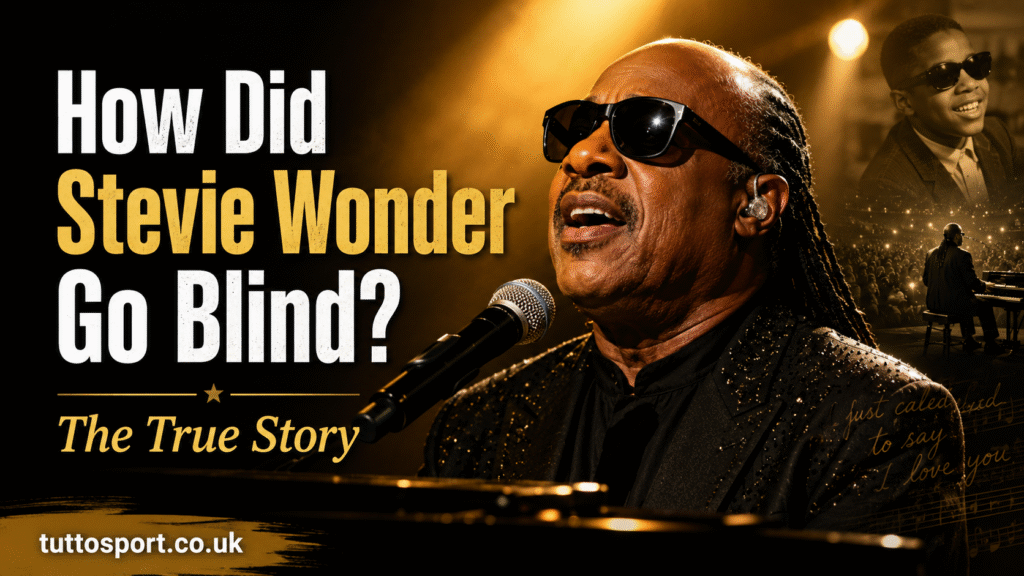
The Story Behind a Legend
Some artists become famous because they can sing. Others become famous because they can write songs, play instruments, or command a stage. Then there is Stevie Wonder, a rare kind of artist who seems to carry music in his bones.
For decades, fans have asked one question with real curiosity: How did Stevie Wonder go blind? It is not a strange question. His blindness is part of his life story, but it has never been the whole story. In fact, the more you learn about Stevie Wonder, the more you realize that his journey is not mainly about losing sight. It is about gaining a voice, a sound, a purpose, and a place in music history that few people will ever reach.
The true story begins when Stevie Wonder was only a baby. He was not born into fame, luxury, or comfort. He was born early, fragile, and facing medical problems that would shape the rest of his life. However, what happened next is what makes his story so unforgettable. Instead of letting blindness define him, he turned sound into a world of color, feeling, rhythm, and soul.
This article explains how Stevie Wonder went blind, what condition caused it, how his childhood shaped his music, and why his life remains one of the most inspiring stories in entertainment.
Stevie Wonder Bio
| Bio Detail | Information |
|---|---|
| Full Name | Stevland Hardaway Morris |
| Date of Birth | May 13, 1950 |
| Age | 76 years old |
| Profession | Singer, songwriter, musician, record producer |
| Nationality | American |
| Net Worth (approx.) | Around $200 million |
| Notable Works / Achievements | “Superstition,” “Isn’t She Lovely,” “Sir Duke,” “I Just Called to Say I Love You,” 25 Grammy Awards, Rock and Roll Hall of Fame, Presidential Medal of Freedom |
How Did Stevie Wonder Go Blind?
The short answer is that Stevie Wonder became blind shortly after birth because of a medical condition called retinopathy of prematurity, often shortened to ROP.
He was born about six weeks premature. Premature babies are more vulnerable because their bodies, including their eyes, are not fully developed at birth. In Stevie’s case, he was placed in an incubator, which was a common medical practice for premature babies. The oxygen-rich environment helped keep him alive, but it also likely contributed to damage in his developing eyes.
Retinopathy of prematurity affects the retina, the light-sensitive tissue at the back of the eye. When abnormal blood vessels grow in the retina, they can cause scarring and retinal detachment. If the damage is severe, it can lead to permanent blindness.
So, when people ask, “How did Stevie Wonder go blind?” the truthful answer is not that he had an accident or became blind later in life. His blindness happened when he was an infant due to complications linked to premature birth and oxygen treatment.
What Is Retinopathy of Prematurity?
Retinopathy of prematurity is an eye disorder that can happen in babies born too early. In simple words, the baby’s retina is still developing, and extra oxygen can disturb normal eye growth.
Why It Happens
ROP can develop when:
- A baby is born prematurely
- The retina has not fully developed
- Abnormal blood vessels grow inside the eye
- The retina becomes damaged or detached
- Oxygen treatment affects fragile eye tissue
Today, doctors understand this condition much better than they did in the 1950s. Modern neonatal care has improved, and premature babies are monitored more carefully. However, when Stevie Wonder was born, medical knowledge was more limited, and many premature infants faced serious risks.
Was Stevie Wonder Born Blind?
This is where many people get confused. Stevie Wonder was not simply “born blind” in the way many people assume. He was born premature, and his blindness developed shortly after birth because of retinopathy of prematurity.
That small detail matters. It helps explain the medical side of his story more clearly. His blindness was not caused by a family curse, an injury, or anything mysterious. It was a known condition connected to early birth and newborn medical care at the time.
Still, for most of his life, Stevie Wonder has lived as a blind person. Because he lost his sight so early, he grew up experiencing the world mainly through sound, touch, rhythm, memory, and emotion.
Stevie Wonder’s Early Life
Stevie Wonder was born in Saginaw, Michigan, as Stevland Hardaway Judkins. Later, his name became Stevland Hardaway Morris. His family eventually moved to Detroit, a city that would become deeply connected to his music career.
Detroit was not just any city. It was the home of Motown, one of the most important record labels in American music history. For a young boy with a gift for music, Detroit was the right place at the right time.
From an early age, Stevie Wonder showed signs of extraordinary talent. He could play several instruments, including the piano, harmonica, and drums. Even as a child, he had a natural understanding of melody and rhythm. People around him noticed that he was not just good for his age. He was special.
A Childhood Built Around Sound
For many children, the world is full of pictures. For Stevie Wonder, the world was full of sound. Church music, street noise, voices, radio songs, footsteps, clapping hands, and instruments all became part of his imagination.
That may be one reason his music feels so alive. He did not write flat songs. He built whole emotional scenes. When you listen to “Sir Duke,” you can almost feel the joy bouncing through the horns. When you hear “Isn’t She Lovely,” you can sense the warmth of a proud father. When “Superstition” plays, the groove grabs you before the lyrics even begin.
How Blindness Shaped Stevie Wonder’s Music
It would be unfair to say blindness made Stevie Wonder talented. His talent was his own. However, blindness did influence how he experienced music and how he connected with sound.
He developed a strong ear. He learned to feel rhythm deeply. He listened closely to voices, instruments, and small details. In addition, he built a musical style that mixed soul, R&B, funk, pop, jazz, gospel, and social commentary.
His Music Was Never Limited
Some people wrongly assume blindness is only a limitation. Stevie Wonder proved that a person can face a major challenge and still build a massive creative life.
He became:
- A singer with a rich and emotional voice
- A songwriter with unforgettable lyrics
- A multi-instrumentalist with rare skill
- A producer who helped shape modern soul music
- A cultural voice for love, equality, justice, and hope
His blindness did not stop him from becoming one of the most influential musicians of all time. Instead, his life showed that talent, discipline, and vision are not always about eyesight.
The Rise of Little Stevie Wonder
Before the world knew him as Stevie Wonder, he was introduced as “Little Stevie Wonder.” That name came from his early days at Motown, where people were amazed by his talent.
He signed with Motown as a child, and his career began while he was still very young. Many child stars fade quickly, but Stevie Wonder did something rare. He grew from a young musical prodigy into a serious adult artist.
That transition is not easy. Many young performers struggle when they get older because audiences keep seeing them as children. However, Stevie Wonder evolved. His voice matured, his songwriting deepened, and his music became more personal and powerful.
Stevie Wonder’s Golden Era
The 1970s were a golden period for Stevie Wonder. During this time, he released some of the greatest albums in popular music. These records were not just successful. They were bold, emotional, experimental, and deeply human.
His classic works include:
| Album | Why It Matters |
|---|---|
| Talking Book | Featured “Superstition” and showed his creative independence |
| Innervisions | Mixed soul, politics, spirituality, and social awareness |
| Fulfillingness’ First Finale | Continued his run of mature, thoughtful music |
| Songs in the Key of Life | Often considered one of the greatest albums ever made |
During this period, Stevie Wonder proved that he was not simply a hitmaker. He was a complete artist. He could write love songs, protest songs, joyful songs, and deeply reflective songs. Moreover, he could make them all feel honest.
Famous Songs That Defined His Legacy
Even people who do not know much about Stevie Wonder usually know his songs. His music has appeared at weddings, parties, films, concerts, award shows, and family gatherings for generations.
Some of His Most Loved Songs
- “Superstition”
- “Isn’t She Lovely”
- “Sir Duke”
- “I Just Called to Say I Love You”
- “Higher Ground”
- “Signed, Sealed, Delivered I’m Yours”
- “You Are the Sunshine of My Life”
- “Living for the City”
- “For Once in My Life”
- “Part-Time Lover”
These songs remain popular because they feel timeless. They do not sound like cold products made for charts. They sound like real emotion turned into melody.
Did Blindness Affect Stevie Wonder’s Career?
Yes, but not in the way some people think. Blindness affected how Stevie Wonder moved through the world, but it did not prevent him from achieving greatness.
He faced challenges, of course. A blind performer must navigate studios, stages, travel, interviews, and public life differently. However, Stevie Wonder had confidence, humor, and independence. He also had a strong support system and a clear belief in his own ability.
In many ways, his career challenged the entertainment industry’s narrow ideas about disability. He showed that a blind artist could be commercially successful, critically respected, and creatively revolutionary.
The Human Side of Stevie Wonder’s Story
One reason people love Stevie Wonder is that his story feels deeply human. He is not just an icon standing far away from ordinary life. His music feels personal. His interviews often show warmth, humor, and thoughtfulness.
He has spoken about blindness with honesty and grace. He does not present himself as a victim. Instead, he often talks about life with a sense of purpose. That attitude is part of why fans admire him so much.
More Than a Musician
Stevie Wonder has also used his fame to support social causes. He has spoken up for civil rights, disability awareness, peace, and humanitarian issues. He played an important role in the campaign to make Martin Luther King Jr. Day a national holiday in the United States.
That part of his legacy matters. His work is not only about entertainment. It is also about using a public voice to push for a better world.
Why People Still Ask About His Blindness
The question “How did Stevie Wonder go blind?” keeps appearing online because people remain fascinated by the contrast between his condition and his success.
There is something powerful about a man who cannot see in the traditional sense yet creates music that helps millions of people feel seen. That is the emotional heart of his story.
However, it is important to ask the question respectfully. Stevie Wonder should not be reduced to blindness. He is not great “because he is blind.” He is great because he is a brilliant musician, songwriter, performer, and cultural figure.
His blindness is one part of his journey, but his talent, hard work, courage, and creativity are what made him a legend.
Common Myths About Stevie Wonder’s Blindness
Over the years, rumors and jokes have circulated about whether Stevie Wonder is really blind. These rumors are not new, and they often spread because people misunderstand blindness.
Blindness is not always the same for every person. Some blind people may have light perception. Some may move with confidence in familiar spaces. Some may turn toward sound or react quickly to movement nearby. None of that means they are pretending.
Myth vs Truth
| Myth | Truth |
|---|---|
| Stevie Wonder went blind in an accident | He became blind shortly after birth due to retinopathy of prematurity |
| He was blinded as an adult | His blindness happened when he was an infant |
| Blind people cannot perform on big stages | Blind artists can perform, travel, create, and lead successful careers |
| His blindness is the only reason he is famous | His fame comes from extraordinary talent, songwriting, and musicianship |
Stevie Wonder’s Awards and Achievements
The career of Stevie Wonder is packed with honors. His success is not based on one hit song or one lucky moment. It comes from decades of work.
Major Career Highlights
- 25 Grammy Awards
- Grammy Lifetime Achievement recognition
- Rock and Roll Hall of Fame induction
- Presidential Medal of Freedom
- Academy Award for Best Original Song
- More than 100 million records sold worldwide
- Influence across R&B, soul, pop, funk, jazz, and gospel music
These achievements show how deeply Stevie Wonder shaped modern music. Many artists have hits. Few change the direction of popular sound.
What Stevie Wonder Teaches Us
The life of Stevie Wonder teaches a simple but powerful lesson: a limitation does not have to become the center of your identity.
He could have been introduced forever as a blind child with talent. Instead, he became one of the greatest musicians in the world. He kept growing. He kept experimenting. He kept writing songs that made people dance, think, cry, and hope.
His story also reminds us that early struggle does not decide the full shape of a life. A difficult beginning can still lead to a remarkable journey.
Why His Story Still Matters Today
In today’s world, people often search for quick inspiration. But the story of Stevie Wonder is not quick. It is layered. It includes medical hardship, family strength, childhood talent, cultural change, artistic risk, and decades of discipline.
Young musicians can learn from his creativity. Writers can learn from his honesty. Fans can learn from his joy. And anyone facing a challenge can learn from the way he refused to live inside other people’s limits.
That is why his story still matters. It is not only about how Stevie Wonder went blind. It is about what he did after that.
Conclusion: The True Story Behind Stevie Wonder’s Blindness
So, how did Stevie Wonder go blind? The true story is that he was born prematurely and developed retinopathy of prematurity shortly after birth. Oxygen treatment in an incubator likely worsened the condition, causing permanent blindness when he was still an infant.
But that medical fact is only the beginning. The larger story is about a boy who turned sound into vision. Stevie Wonder became one of the most loved and respected musicians in history, not because life was easy, but because his gift was powerful and his spirit was even stronger.
His songs continue to inspire new generations. His voice still feels warm, bold, and alive. His journey proves that greatness is not limited by what a person lacks. Sometimes, it is revealed by what a person chooses to build anyway.
If this story helped you understand Stevie Wonder better, share it with someone who loves music, inspiring life stories, or legendary artists. And feel free to leave your thoughts: which Stevie Wonder song means the most to you?