

Jeffrey Manchester: The True Story Behind Roofman

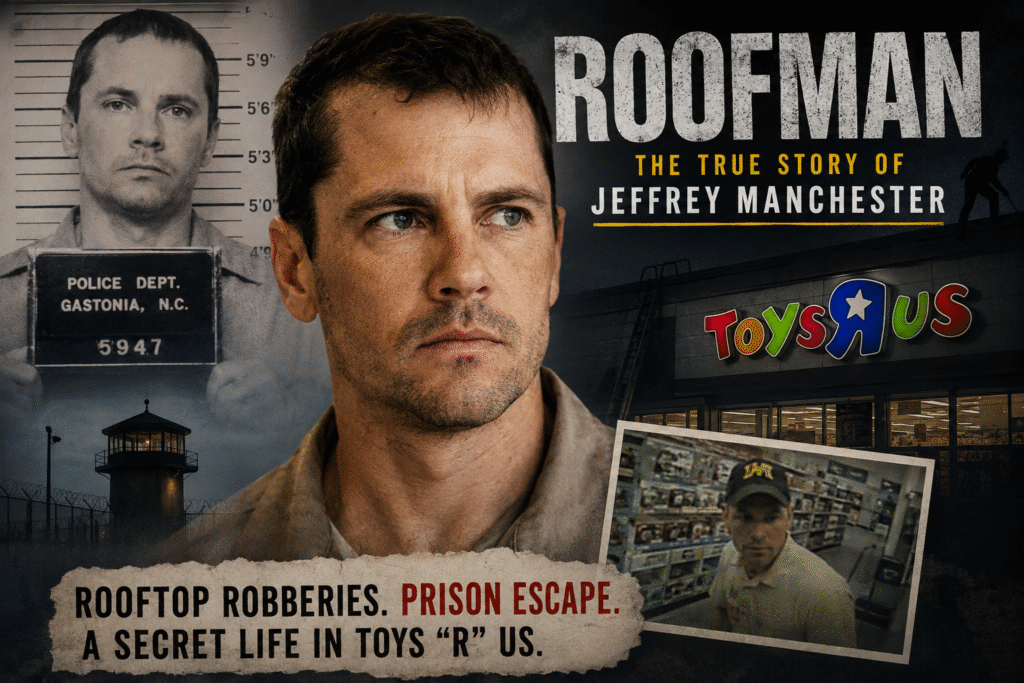
Jeffrey Manchester: The True Story Behind Roofman
Jeffrey Manchester became known as “Roofman” because of an unusual method he used to rob fast-food restaurants: entering through holes cut into their roofs. His story later became the basis for the 2025 film Roofman, starring Channing Tatum, bringing renewed attention to a criminal case that had already attracted national interest.
But the real story of Jeffrey Manchester is more complicated than a Hollywood crime drama. Before becoming a convicted robber, he served in the U.S. Army and became a father. In the late 1990s and 2000, he carried out a series of robberies across several states. After his arrest and a lengthy prison sentence, he escaped from a North Carolina correctional facility in 2004.
What happened next made his case especially unusual. Manchester managed to remain hidden in Charlotte for months, secretly living inside retail properties while presenting himself to people outside as someone else. He even developed a relationship with a woman who did not know his true identity.
This article examines Jeffrey Manchester, his background, criminal activity, prison escape, time in hiding, capture, and the real events behind Roofman.
Key Takeaways
- Jeffrey Manchester is an American convicted robber known as “Roofman.”
- He became notorious for entering fast-food restaurants through their roofs during a robbery spree in the late 1990s and 2000.
- He was arrested in North Carolina in May 2000 and received a lengthy prison sentence.
- In June 2004, Manchester escaped from Brown Creek Correctional Institution by hiding underneath a prison delivery truck.
- He subsequently hid for months inside a Charlotte Toys “R” Us and nearby retail space while using the alias John Zorn.
- His extraordinary story became the inspiration for the 2025 film Roofman, directed by Derek Cianfrance and starring Channing Tatum.
Biography Table
| Detail | Information |
|---|---|
| Full Name | Jeffrey Allen Manchester |
| Date of Birth | November 12, 1971 |
| Age | 54 as of August 2026 |
| Birthplace | Sacramento, California, United States |
| Nationality | American |
| Profession | Former U.S. Army sergeant; convicted robber |
| Education | High school in Rancho Cordova is publicly reported; further education is not clearly established |
| Years Active | Criminal activity primarily reported from the late 1990s to 2000, with later activity following his 2004 escape |
| Known For | “Roofman” robberies, prison escape and hiding inside a Toys “R” Us |
| Major Achievements | Not applicable; his public notoriety comes from his criminal case and its later adaptation into Roofman |
The reported birth date and birthplace are consistent with biographical records and contemporary reporting.
Who Is Jeffrey Manchester?
Jeffrey Manchester is a former U.S. Army sergeant who became infamous for a series of unusual commercial robberies. His nickname, “Roofman,” came from his practice of entering restaurants through their roofs rather than using conventional entrances.
Manchester’s background makes the story particularly striking. He was not initially known as a career criminal. He served in the military, including with the 82nd Airborne Division, and developed skills associated with military training. Later accounts of his life have connected some of those skills to the planning and execution of his robberies.
His criminal activity eventually led to arrest, conviction and imprisonment. Yet even incarceration did not end the story. His 2004 escape and subsequent months as a fugitive transformed an unusual robbery case into one of the strangest criminal stories associated with North Carolina.
Jeffrey Manchester’s Military Background
Before the robberies made him famous, Manchester served in the U.S. Army. Reports identify him as having served with the 82nd Airborne Division and as a sergeant in the Army Reserve.
His military experience included training associated with parachuting and other physical and tactical skills. Reporting has suggested that his familiarity with rooftops, climbing and movement helped him develop the unusual method that later earned him the Roofman nickname.
Manchester also had a family life during this period. He married young and had children. His family circumstances later became part of explanations he gave for why he turned toward crime, although those explanations do not excuse the harm caused by his actions.
In a 2026 interview from prison, Manchester said he had convinced himself that obtaining more money would improve life for his children. He also acknowledged that his actions harmed the people he threatened and that he had previously rationalized the crimes as essentially victimless.
That distinction matters when examining the case. Understanding someone’s stated motivation is not the same as accepting it as justification.
How Jeffrey Manchester Became the “Roofman”
Manchester’s criminal method was unusual enough to produce a memorable nickname.
Rather than simply walking into restaurants, he would gain access from above. He cut or drilled openings into roofs and entered fast-food establishments after hours or around opening time. Once inside, he could surprise employees and demand money.
The approach required planning and knowledge of the buildings he targeted. It also carried obvious risks, including the possibility of structural accidents, confrontation with employees or intervention by police.
Reports have attributed dozens of robberies to Manchester across multiple states during his criminal spree. The exact totals vary between accounts, so it is more responsible to describe the case as involving dozens of robberies rather than rely on one disputed number.
Why McDonald’s Restaurants Became a Major Target
McDonald’s locations became strongly associated with Manchester’s criminal activity.
The restaurants had characteristics that made them attractive targets: predictable layouts, cash-handling procedures and roof structures that Manchester believed he could exploit. His approach involved entering from above, confronting employees and taking money from the premises.
However, the idea that the crimes were harmless because they targeted businesses is misleading. Employees were placed under extreme psychological pressure and, in some cases, physically confined.
Manchester himself later acknowledged this point. In his 2026 interview with WBTV, he said he had once viewed the robberies as a victimless crime but eventually recognized the emotional harm inflicted on the people he threatened.
The 2000 McDonald’s Robberies
The case reached a turning point in Gaston County, North Carolina, on May 20, 2000.
Manchester first robbed a McDonald’s in Gastonia during the early morning hours. According to reporting based on case records, he entered through the roof, confronted employees and took money from the restaurant.
Approximately five hours later, he attempted a similar robbery at another McDonald’s in Belmont.
This second robbery would prove decisive.
An employee activated a silent alarm, bringing law enforcement into the situation. Manchester was subsequently captured in a nearby church parking lot.
The two North Carolina robberies became central to the prosecution that followed.
Arrest, Conviction and Prison Sentence
Manchester was arrested in May 2000 and prosecuted for serious offenses connected with the robberies.
Accounts differ slightly in how the resulting sentence is described, but contemporary reporting consistently places the original punishment at roughly four decades, with 45 years commonly cited. The Charlotte Observer reported that Manchester was sentenced to 45 years in prison in November 2000.
He was eventually incarcerated at Brown Creek Correctional Institution in North Carolina.
For many defendants, that would have been the end of the public story.
For Manchester, it was only the beginning of an even more extraordinary chapter.
Jeffrey Manchester’s 2004 Prison Escape
On June 15, 2004, Manchester escaped from Brown Creek Correctional Institution.
The escape depended on his access to the facility’s metalworking operation. According to Manchester’s later account, he used tools and equipment available through his work to modify a truck and create a concealed space underneath it.
He then used the vehicle to leave the prison grounds while hiding beneath it.
The escape was not a spontaneous decision. Manchester later said that he had considered escape plans at previous facilities and had developed the Brown Creek plan while working in the prison’s metal plant.
Once outside prison, Manchester was again a fugitive.
His next decision would make the case famous.
The Toys “R” Us Hideout
After escaping, Manchester made his way to Charlotte, North Carolina.
Instead of immediately leaving the region, he searched for a place where he could hide for an extended period. He eventually concealed himself inside a Toys “R” Us store.
The idea sounds almost impossible, but Manchester managed to remain hidden inside the retail environment for months. Reports describe him creating concealed living areas and using the store’s resources to survive.
The unusual hiding place offered one major advantage: he could remain close to food, shelter and everyday activity while avoiding the outside world.
He reportedly monitored employee movements and adapted his routine around the store’s operating schedule.
Living Behind the Walls
Manchester did not simply sleep in an obvious corner of the store.
He created concealed spaces where he could remain unseen during normal business operations. When employees and customers were present, he stayed hidden. When the building became quieter, he could move around.
This required extraordinary patience.
For months, an escaped prisoner was effectively living inside a busy retail environment without being recognized by the people working there.
Later accounts also describe Manchester using baby monitors and other equipment to monitor activity around the store.
The story became even more complicated as the holiday shopping season increased activity at the store. Manchester eventually moved between hidden spaces associated with the Toys “R” Us and an adjacent former Circuit City property.
Jeffrey Manchester and the Alias John Zorn
While living as a fugitive, Manchester did not publicly identify himself as an escaped prisoner.
He used the name John Zorn and attempted to construct a different identity.
That new identity allowed him to interact with people outside his hiding place and become part of a local community. Instead of living entirely as an isolated fugitive, he began attending church.
This was a critical development because it brought him into contact with people who had no reason to suspect that he was wanted by authorities.
Jeffrey Manchester and Leigh Wainscott
One of the most personal parts of the story involved Manchester’s relationship with Leigh Wainscott, who was unaware of his real identity.
Manchester presented himself as John Zorn. Wainscott met him through the local community, and their relationship developed while Manchester was secretly living as a fugitive.
The relationship added a human dimension to the case, but it also created another vulnerability for Manchester.
The closer he became to people, the harder it became to keep his identity hidden.
When authorities eventually informed Wainscott that the man she knew as John was actually Jeffrey Manchester, she was placed in an extraordinarily difficult position. Reporting has described how she ultimately helped police bring the fugitive into custody.
How Jeffrey Manchester Was Captured
Manchester’s second period as a fugitive ended in early 2005.
After investigators connected his assumed identity with his real one, authorities turned to people who had interacted with him. Wainscott became an important part of the effort to locate him.
The arrest brought an end to months of hiding.
It also exposed just how extensive Manchester’s deception had been. He had escaped prison, lived secretly in commercial properties and established relationships while authorities searched for him.
Following his capture, Manchester returned to prison and faced additional legal consequences related to his escape and subsequent crimes.
Where Is Jeffrey Manchester Now?
Jeffrey Manchester remains incarcerated in North Carolina.
Recent reporting has identified him as being held at Central Prison in Raleigh. In a 2026 WBTV interview, Manchester spoke by telephone from prison about his criminal history, his escape and the decisions that led to his fugitive years.
Public reporting has given a projected release date in 2036, although prison release information can depend on legal and administrative factors.
His continued incarceration is an important distinction between the real story and fictional portrayals. The film version of Manchester is a dramatized character, while the real Jeffrey Manchester remains a convicted prisoner.
Jeffrey Manchester and the Film Roofman
The story of Jeffrey Manchester became the basis for Roofman, a 2025 crime drama directed by Derek Cianfrance and starring Channing Tatum as Manchester.
The film also features Kirsten Dunst and dramatizes Manchester’s robberies, escape, hidden life and relationship with Leigh.
Cianfrance spent years researching the story and communicating with Manchester. TIME reported that the director received multiple phone calls from Manchester each week over a period of years while developing the project.
That level of contact gave the filmmaker access to Manchester’s own perspective, but it also highlights an important issue with true-crime storytelling: a convicted criminal’s account is still one perspective.
How Much of Roofman Is True?
The basic foundation of Roofman is real.
These major elements are rooted in the documented case:
- Manchester’s rooftop restaurant robberies
- His arrest and imprisonment
- His 2004 prison escape
- His hiding inside a Toys “R” Us
- His use of an assumed identity
- His relationship with Leigh
- His eventual capture
However, a feature film is not a court transcript.
Characters can be combined, events can be rearranged, conversations can be invented and timelines can be compressed to create a coherent dramatic story. Contemporary coverage of Roofman has specifically noted that the filmmakers took creative liberties with the real events.
For readers interested in the real Jeffrey Manchester, it is therefore useful to separate the historical record from the movie’s dramatic interpretation.
Why the Roofman Story Became So Fascinating
The case stands out because it combines several seemingly incompatible elements.
Manchester’s story contains:
- A military background — He served as an Army sergeant.
- An unusual criminal method — He entered restaurants through their roofs.
- A major prison sentence — His first conviction resulted in decades behind bars.
- A remarkable escape — He concealed himself beneath a prison delivery truck.
- An extraordinary hideout — He lived secretly inside a Toys “R” Us.
- A false identity — He presented himself as John Zorn.
- A relationship built on deception — He became close to someone who did not know his true history.
- A Hollywood adaptation — His life eventually inspired a major feature film.
The combination is unusual enough that it can sound fictional even when the central events are documented.
What Jeffrey Manchester Has Said About His Crimes
One of the most revealing recent developments has been Manchester’s willingness to discuss his own actions.
In his 2026 interview with WBTV, he rejected the idea that his crimes could be excused. He acknowledged that his earlier thinking had been deeply flawed and said that he had harmed people emotionally.
That perspective is significant because much of the public fascination with the Roofman case focuses on the cleverness of the escape or the bizarre Toys “R” Us hiding place.
Those elements are undeniably unusual, but they should not obscure the central reality: Manchester’s actions involved threats, fear, property crimes and serious consequences for victims.
Understanding the full story means recognizing both the extraordinary circumstances and the human cost.
Frequently Asked Questions
Who is Jeffrey Manchester?
Jeffrey Manchester is an American convicted robber who became known as “Roofman” for entering fast-food restaurants through their roofs during a series of robberies. His later prison escape and months hiding in a Toys “R” Us made his case especially notorious.
Why was Jeffrey Manchester called Roofman?
He earned the nickname because he repeatedly gained entry to restaurants by cutting or drilling openings through their roofs rather than entering through normal doors.
Was Jeffrey Manchester really in the Army?
Yes. Manchester served in the U.S. Army and was reported to have served with the 82nd Airborne Division. He was also an Army Reserve sergeant around the time of his arrest.
Did Jeffrey Manchester really escape from prison?
Yes. On June 15, 2004, he escaped from Brown Creek Correctional Institution by hiding underneath a delivery truck after using resources available through his work at the prison.
Did Jeffrey Manchester really live inside a Toys “R” Us?
Yes. After escaping, Manchester secretly lived inside a Charlotte Toys “R” Us and associated retail space for months. Reports describe concealed living areas and methods he used to monitor activity inside the store.
Who is Leigh Wainscott in the Jeffrey Manchester story?
Leigh Wainscott was a woman Manchester met while living under the alias John Zorn. She did not initially know that he was an escaped prisoner. She later became involved in the circumstances that led to his capture.
Is Roofman based on a true story?
Yes. The 2025 film Roofman, directed by Derek Cianfrance and starring Channing Tatum, is based on the real case of Jeffrey Manchester. However, like most dramatizations, it changes or compresses some details for storytelling purposes.
Where is Jeffrey Manchester today?
Recent reporting places Manchester in prison at Central Prison in Raleigh, North Carolina. Public reports have cited a projected release date in 2036.
Conclusion
The story of Jeffrey Manchester is remarkable not because crime itself is unusual, but because of the extraordinary sequence of events surrounding his case.
A former Army sergeant became known for a distinctive pattern of rooftop robberies. His arrest in 2000 led to a lengthy prison sentence, but four years later he escaped by hiding beneath a prison truck. He then managed to disappear into Charlotte, where he secretly lived inside a Toys “R” Us and adopted the identity of John Zorn.
His relationship with Leigh Wainscott ultimately became one of the key elements in his downfall, helping authorities close in on him after months as a fugitive.
The 2025 film Roofman brought the case to a much wider audience, but the real story remains more complicated than its cinematic version. Jeffrey Manchester’s own later reflections also add an important perspective: whatever motivations he believed he had, his crimes frightened and harmed real people.
That is ultimately what makes the Jeffrey Manchester case worth understanding beyond its strangest details. It is a story of crime, deception, escape and consequences—and a reminder that extraordinary circumstances do not erase the human impact of criminal actions.