

Dar Preterite: Rules, Examples & Common Errors

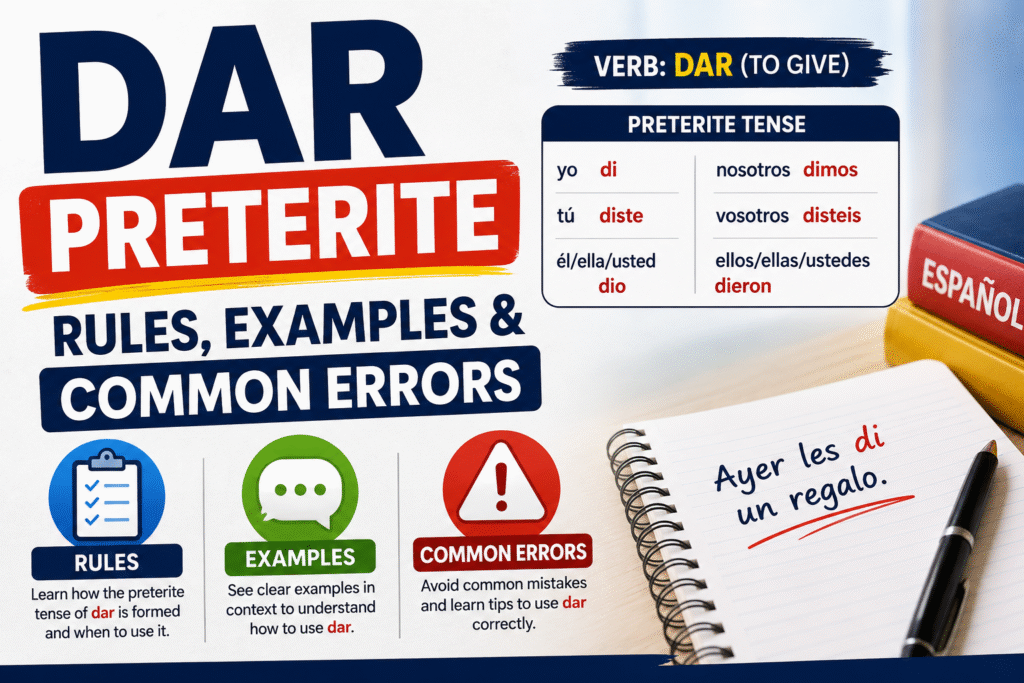
Dar Preterite: Rules, Examples & Common Errors
Learning Spanish verb conjugations can feel complicated, especially when a verb does not follow the patterns you expect. Dar preterite is a good example. The verb dar, meaning “to give,” is extremely common in Spanish, but its preterite forms are irregular.
The good news is that the dar preterite is actually easier to memorize than many irregular Spanish verbs. Its forms are short, distinctive, and follow a pattern that becomes familiar with practice.
In this guide, you will learn how to conjugate dar in the preterite tense, understand when to use each form, see the verb in realistic sentences, and avoid the most common mistakes. You will also learn how dar behaves with pronouns, indirect objects, and common expressions.
Key Takeaways
- The preterite of dar is irregular and uses the forms di, diste, dio, dimos, disteis, dieron.
- The preterite describes completed actions in the past.
- The dar forms do not contain the expected accent marks found in some regular preterite verbs.
- Dar can mean “to give,” but its meaning changes in many common expressions.
- Indirect object pronouns such as me, te, le, nos, and les are frequently used with dar.
- Context helps determine whether the action should be expressed in the preterite or another Spanish past tense.
Dar Preterite Conjugation
The Spanish verb dar means “to give.” In the preterite tense, it has six basic forms.
| Subject | Dar in the Preterite | English |
|---|---|---|
| yo | di | I gave |
| tú | diste | you gave |
| él / ella / usted | dio | he/she/you gave |
| nosotros / nosotras | dimos | we gave |
| vosotros / vosotras | disteis | you all gave |
| ellos / ellas / ustedes | dieron | they/you all gave |
These forms are important to memorize because dar does not follow the normal endings you might expect from a regular -ar verb.
For example, a regular verb such as hablar becomes:
- hablé
- hablaste
- habló
- hablamos
- hablasteis
- hablaron
But dar becomes:
- di
- diste
- dio
- dimos
- disteis
- dieron
Notice that the forms are unusually short.
Why Is Dar Irregular in the Preterite?
The verb dar is irregular in several parts of Spanish grammar, and its preterite forms do not follow the standard conjugation pattern for regular -ar verbs.
A particularly useful point for learners is that dar does not take the usual accent marks in its preterite forms.
For example:
- di, not dí
- dio, not dió
This is a common source of mistakes.
The form dimos can also look familiar because it is identical to the present-tense form of dar for nosotros. Context tells you whether it means “we give” or “we gave.”
For example:
Dimos el regalo ayer.
We gave the gift yesterday.
Here, ayer (“yesterday”) clearly establishes that dimos is being used as a preterite form.
When to Use the Dar Preterite
The preterite is generally used for actions that happened and were completed in the past.
With dar, this can include giving something, offering something, delivering something, granting permission, making a presentation, or performing another completed action depending on the context.
Completed Giving Actions
Use the preterite when the act of giving happened at a specific point or during a completed period.
Examples:
- Di el libro a María.
I gave the book to María. - Ella dio dinero a su brother.
She gave money to her brother. - Dimos los regalos el sábado.
We gave the gifts on Saturday. - Ellos dieron comida a los niños.
They gave food to the children.
The action is presented as completed rather than ongoing.
Actions Connected to a Specific Time
Time expressions often make the preterite especially clear.
Common expressions include:
- ayer — yesterday
- anoche — last night
- la semana pasada — last week
- el año pasado — last year
- hace dos días — two days ago
- esta mañana — this morning
- el lunes — on Monday
For example:
Le di el documento ayer.
I gave him/her the document yesterday.
Nos dieron la noticia el lunes.
They gave us the news on Monday.
Dio una respuesta esta mañana.
He/she gave an answer this morning.
The time reference helps establish the completed nature of the event.
Dar Preterite With Direct and Indirect Objects
One of the most important things to understand about dar is that it frequently appears with an indirect object.
In English, we might say:
I gave Sarah the book.
In Spanish, you can say:
Le di el libro a Sarah.
Here:
- le = to her
- di = I gave
- el libro = the book
- a Sarah = clarifies who le refers to
This structure is extremely common.
Common Indirect Object Pronouns
| Spanish Pronoun | Meaning |
|---|---|
| me | to me |
| te | to you |
| le | to him, her, you |
| nos | to us |
| os | to you all |
| les | to them, you all |
Examples include:
- Me dio un regalo. — He/she gave me a gift.
- Te di mi número. — I gave you my number.
- Le dimos las llaves. — We gave him/her the keys.
- Nos dieron una oportunidad. — They gave us an opportunity.
- Les diste el dinero. — You gave them the money.
Dar Preterite in Everyday Spanish
Although dar literally means “to give,” Spanish speakers use it in many expressions where a direct translation may sound different in English.
Learning these combinations can make the preterite much easier to recognize.
Dar una oportunidad
Dar una oportunidad means “to give an opportunity” or “to give someone a chance.”
El profesor me dio una oportunidad.
The teacher gave me a chance.
Dar un consejo
Dar un consejo means “to give advice.”
Mi padre me dio un buen consejo.
My father gave me good advice.
Dar una respuesta
Dar una respuesta means “to give an answer” or “provide an answer.”
Ella dio una respuesta clara.
She gave a clear answer.
Dar un regalo
This means “to give a gift.”
Le di un regalo a mi hermana.
I gave my sister a gift.
Dar permiso
Dar permiso means “to give permission” or “allow.”
Mis padres me dieron permiso.
My parents gave me permission.
These expressions are useful because they show how frequently dar appears in ordinary Spanish communication.
Dar Preterite Examples by Subject
Seeing every form in complete sentences is one of the best ways to remember the conjugation.
Yo: Di
Di el dinero a mi amigo.
I gave the money to my friend.
Di una respuesta después de pensarlo.
I gave an answer after thinking about it.
Tú: Diste
Diste un regalo a Ana.
You gave Ana a gift.
Diste una buena explicación.
You gave a good explanation.
Él, Ella, Usted: Dio
Él dio el libro a su profesor.
He gave the book to his teacher.
Ella dio una excelente presentación.
She gave an excellent presentation.
Usted dio una respuesta correcta.
You gave a correct answer.
Nosotros: Dimos
Dimos comida a los invitados.
We gave food to the guests.
Dimos las gracias después de la cena.
We gave thanks after dinner.
Vosotros: Disteis
This form is mainly used in Spain.
Disteis una respuesta muy rápida.
You all gave a very quick answer.
Disteis los regalos ayer.
You all gave the gifts yesterday.
Ellos, Ellas, Ustedes: Dieron
Dieron dinero para la causa.
They gave money to the cause.
Los estudiantes dieron sus opiniones.
The students gave their opinions.
Dar Preterite vs. Present Tense
One potential source of confusion is that some preterite forms of dar resemble forms learners may already know.
The most notable example is damos versus dimos.
| Tense | Form | Meaning |
|---|---|---|
| Present | damos | we give / we are giving |
| Preterite | dimos | we gave |
Compare these sentences:
Damos regalos en diciembre.
We give gifts in December.
This describes a regular or habitual action.
Dimos regalos ayer.
We gave gifts yesterday.
This describes a completed past event.
The surrounding context is often enough to distinguish them.
Dar Preterite vs. Imperfect
Another important distinction is between the preterite and imperfect.
The preterite generally presents an action as completed.
The imperfect often describes habitual, repeated, ongoing, or background actions in the past.
Compare:
Le di dinero ayer.
I gave him/her money yesterday.
The action happened and was completed.
Now compare:
Le daba dinero cada semana.
I used to give him/her money every week.
The imperfect presents the action as something that happened repeatedly or habitually.
A Simple Comparison
| Preterite | Imperfect |
|---|---|
| di | daba |
| gave | used to give / was giving |
| completed event | habitual or ongoing past action |
| Di dinero ayer. | Le daba dinero cada semana. |
Understanding this distinction is more useful than simply memorizing conjugation tables.
Common Dar Preterite Mistakes
Even though the conjugation is short, learners frequently make a few predictable errors.
Mistake 1: Adding an Accent to Dio
A common incorrect spelling is:
dió
The correct spelling is:
dio
The preterite form dio does not carry an accent mark.
Mistake 2: Using a Regular -AR Ending
Some learners try to conjugate dar like a regular -ar verb and produce forms that do not exist.
The correct forms are:
di, diste, dio, dimos, disteis, dieron
Do not try to apply the regular -ar endings directly to dar.
Mistake 3: Confusing Di With Another Spanish Word
The short form di can be confusing because it has multiple grammatical uses in Spanish.
In the context of dar, di means:
I gave.
For example:
Di el libro a Juan.
I gave the book to Juan.
The surrounding words usually make the meaning clear.
Mistake 4: Forgetting the Indirect Object Pronoun
English and Spanish can organize the idea of giving differently.
Instead of simply translating word for word, pay attention to the recipient.
Le di el libro a Carlos.
The phrase le identifies the recipient, while a Carlos specifies who that recipient is.
Mistake 5: Using Preterite for Every Past Action
Not every past action should use the preterite.
If the action was habitual, ongoing, or provided background information, the imperfect may be more appropriate.
Compare:
Le di dinero una vez.
I gave him/her money once.
and:
Le daba dinero todos los meses.
I used to give him/her money every month.
The first describes a completed event. The second describes a repeated past habit.
A Simple Way to Memorize Dar Preterite
Because the forms are irregular, memorization is useful. However, memorizing them as isolated words is not the only strategy.
Start with the six forms:
di → diste → dio → dimos → disteis → dieron
Then group them by their endings:
- di
- diste
- dio
- dimos
- disteis
- dieron
Next, practice them in short sentences.
For example:
- Di un regalo.
- Diste un consejo.
- Dio una respuesta.
- Dimos comida.
- Disteis permiso.
- Dieron dinero.
Finally, add time expressions:
- ayer
- anoche
- la semana pasada
- el año pasado
- hace dos días
This turns memorization into meaningful language practice.
Dar Preterite Practice Exercise
Try completing these sentences with the correct preterite form of dar.
- Yo ___ un regalo a María.
- Tú ___ una buena respuesta.
- Ella ___ dinero a su hermano.
- Nosotros ___ comida a los invitados.
- Vosotros ___ permiso a los estudiantes.
- Ellos ___ las gracias después de la reunión.
Answers
- di
- diste
- dio
- dimos
- disteis
- dieron
A useful next step is to create your own sentences using each form. Personal examples are often easier to remember than textbook sentences.
Frequently Asked Questions
What is the preterite form of dar?
The preterite forms of dar are di, diste, dio, dimos, disteis, and dieron.
Is dar regular in the preterite?
No. Dar is irregular in the preterite. Its forms do not follow the standard pattern used by regular Spanish -ar verbs.
Does dio have an accent?
No. The correct spelling is dio, without an accent mark. Writing dió is incorrect under modern Spanish spelling rules.
What does di mean in Spanish?
In the context of dar, di means “I gave.” For example, Di el libro means “I gave the book.”
What is the difference between di and daba?
Di is the preterite form and normally describes a completed past action. Daba is the imperfect form and can describe an ongoing, habitual, or repeated past action.
Is dimos present or preterite?
Dimos is the preterite form of dar for nosotros. The present-tense form is damos. Context can make the distinction clear.
How do you say “I gave” using dar?
“I gave” is di in Spanish. For example, Di un regalo a mi amiga means “I gave a gift to my friend.”
Why is dar preterite important to learn?
Dar is a very common Spanish verb and appears in many everyday expressions, including dar un regalo, dar un consejo, dar permiso, and dar una respuesta. Knowing its preterite forms makes it easier to talk about completed actions in the past.
Conclusion
The dar preterite is an essential Spanish conjugation to learn because dar appears constantly in everyday communication. Although its forms are irregular, they are relatively short and become easy to recognize with regular practice.
The six forms are:
di, diste, dio, dimos, disteis, dieron
The key is to connect these forms with real situations rather than memorizing a table alone. Practice sentences involving gifts, advice, permission, answers, money, and other common uses of dar. Also remember that dio is written without an accent and that dimos is different from the present-tense damos.
Once you understand when to use the preterite and how dar works with indirect object pronouns, you can use this important verb much more naturally and confidently in Spanish.