
Public Procurement in Denmark and the EU: Legal Considerations for Businesses

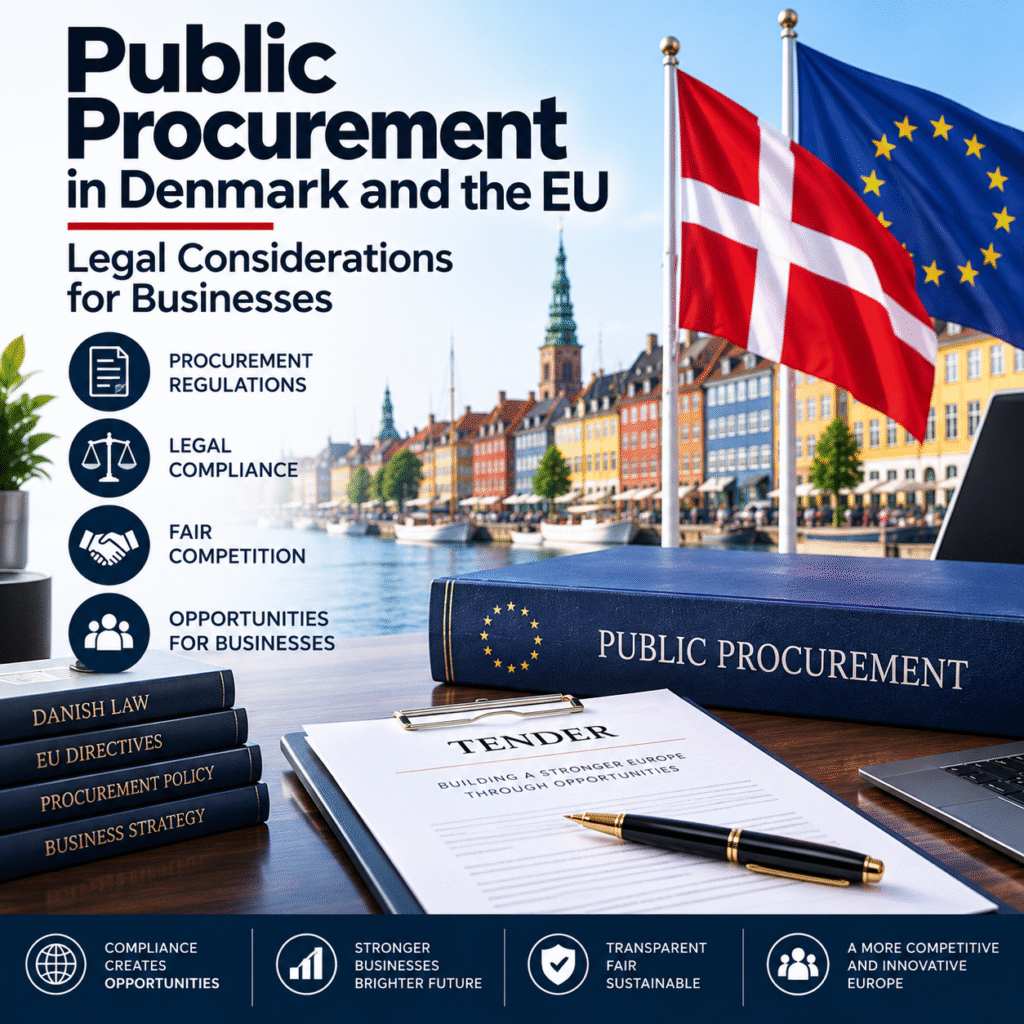
Public procurement can create significant opportunities for companies that supply goods, services, technology, construction, or specialist expertise. At the same time, tender procedures are governed by formal rules designed to promote transparency, equal treatment, and fair competition. A commercially strong bid can still face problems if mandatory requirements, deadlines, or procedural rules are misunderstood.
Read the Tender as a Legal and Commercial Document
Tender materials define the competition. Businesses should identify mandatory eligibility requirements, award criteria, documentation obligations, submission formats, deadlines, and any conditions that could lead to exclusion. Questions should be raised early where the material is unclear, because assumptions made by the bidder may not match the contracting authority’s interpretation.
The commercial team should also understand the proposed contract. Pricing may look attractive until the bidder considers liability, performance guarantees, service levels, change procedures, intellectual property, termination rights, or indexation. Public contracts can provide limited room for negotiation after award, so legal review is often most valuable before the bid is submitted.
Build a Compliant Bid Process Internally
Tender work often involves sales, finance, technical specialists, management, and external partners. A structured internal process helps ensure that required declarations and documents are complete and consistent. One person should own the submission timetable, while subject-matter experts confirm the accuracy of their sections. Last-minute assembly increases the chance that a mandatory form, signature, or attachment will be missed.
Consortia and subcontracting arrangements deserve particular attention. The bid should accurately describe which entity provides which resources and whether reliance on another organization’s capacity is permitted. The legal relationship among consortium members should also be clear so that responsibilities do not remain unresolved after an award.
Know When a Procurement Decision Can Be Challenged
Not every unsuccessful bid indicates a legal problem. However, procurement rules may provide remedies where the process has not complied with applicable requirements. A bidder that believes it has been treated unequally or that the authority has departed from the stated criteria should act quickly, because procedural time limits can be important.
Businesses looking for legal support on Danish and EU procurement questions can consider Lead Roedl, whose published practice areas include advising bidders, contracting entities, and their advisers on national and EU public procurement matters.
Contract Management Matters After the Award
Winning the tender is only the beginning. Public contracts may impose detailed reporting, performance, audit, documentation, and change-control obligations. Project managers should understand which deviations require written approval and whether proposed changes could create procurement-law concerns. Informal changes agreed during delivery can be risky if they conflict with the contract or procurement framework.
Suppliers should therefore treat the tender documents, final contract, clarifications, and award correspondence as an integrated set of obligations. A handover from the bid team to the delivery team is essential so that commercial promises made during the competition are not lost.
Use Clarification Periods Strategically
Where a procurement procedure allows questions, bidders should use the clarification stage carefully. Questions can help resolve inconsistent requirements, confirm how evidence should be presented, or identify whether an alternative technical approach is acceptable. The goal is not to rewrite the tender but to remove uncertainty before submission. Teams should track every published clarification because later answers may modify how the original material must be read.
Prepare for Procurement as a Repeatable Capability
Companies that regularly pursue public contracts can improve results by creating a reusable compliance process: standard document checklists, approval thresholds, legal review points, responsibility matrices, and lessons learned after each bid. The goal is not to turn every tender into a legal project, but to identify the points where procedural accuracy can determine whether a strong commercial offer is even considered.