

Deford Bailey: The First Black Star of the Opry

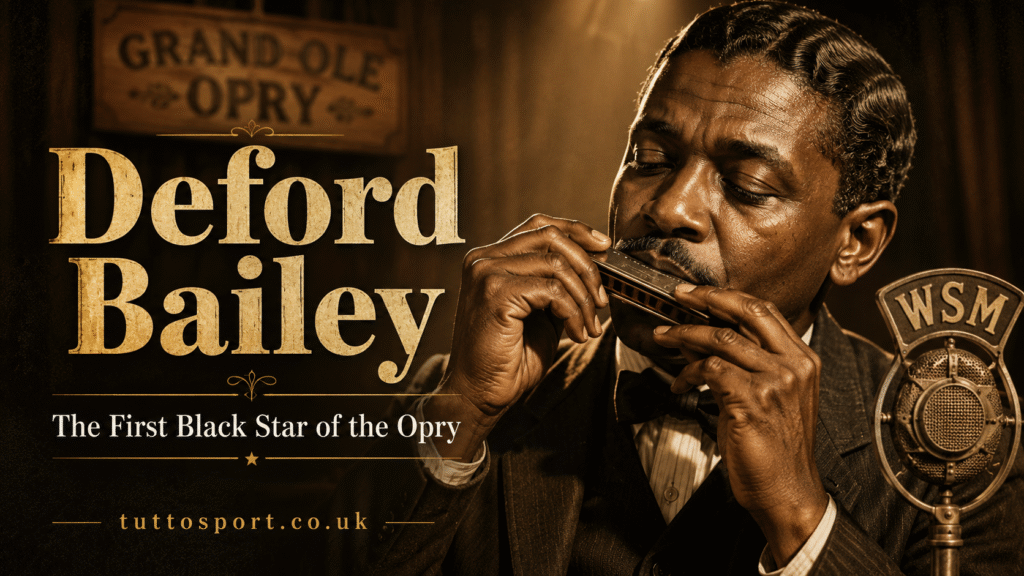
Deford Bailey: The First Black Star of the Opry
Some names in music history shine loudly. Others glow quietly, waiting for the world to look back and understand how much they truly mattered. Deford Bailey belongs to that second group. He was not just a talented harmonica player. He was a trailblazer, a survivor, a country music pioneer, and one of the earliest stars of the Grand Ole Opry.
Long before country music became a global industry, Deford Bailey was already creating sounds that could stop people in their tracks. His harmonica carried the rhythm of trains, the feeling of rural life, the blues of hardship, and the spirit of the American South. He played with a style so vivid that listeners could almost see the scenes he created through sound.
Yet his story is not only about music. It is also about race, fame, struggle, and recognition. As a Black artist in early twentieth-century America, Deford Bailey faced barriers that many white performers did not. Still, he earned a place on one of the most important stages in country music. That alone makes his story powerful. But what makes it unforgettable is how much he gave to American music while receiving far less credit than he deserved during his lifetime.
This article looks closely at the life of Deford Bailey, his rise to fame, his role at the Grand Ole Opry, and why his legacy still matters today.
Deford Bailey Bio
| Detail | Information |
|---|---|
| Full Name | Deford Bailey |
| Date of Birth | December 14, 1899 |
| Age | Died at age 82 |
| Profession | Harmonica player, country musician, blues performer |
| Nationality | American |
| Net Worth (approx.) | Not publicly documented |
| Notable Works / Achievements | First Black star of the Grand Ole Opry, known for “Pan American Blues,” country harmonica pioneer |
Who Was Deford Bailey?
Deford Bailey was an American musician best known for his remarkable harmonica playing and his historic role as one of the first major performers on the Grand Ole Opry. He was born in Tennessee and grew up during a time when racial division shaped almost every part of public life. Despite that, his talent gave him a voice that crossed boundaries.
He became famous for his ability to imitate trains, animals, and rural sounds through the harmonica. His music blended country, blues, folk, and old-time traditions. That mix made him stand out. He did not need a large band or a polished stage show. With one small instrument, Deford Bailey could hold an audience completely.
Many people remember him as “The Harmonica Wizard,” and the nickname was well earned. His playing was fast, sharp, emotional, and full of life. It sounded simple at first, but anyone who listens closely can hear the skill behind it. He understood timing. He understood rhythm. Most of all, he understood how to tell a story without saying a word.
Early Life and Childhood Struggles
Deford Bailey was born in Smith County, Tennessee, and later grew up near Nashville. His childhood was not easy. As a young boy, he suffered from polio, which affected his body and limited his physical movement. However, that hardship also shaped part of his musical path.
Because he could not always take part in the same physical activities as other children, Bailey spent more time listening, observing, and practicing music. The harmonica became more than a toy or pastime. It became his voice. It gave him a way to express what he saw and felt around him.
Rural Tennessee was full of sounds: trains passing, workers moving through fields, church music, front porch songs, and the everyday rhythm of small communities. Deford Bailey absorbed all of it. Later, those sounds came out through his harmonica in a style that felt deeply personal and unmistakably Southern.
His early life also placed him close to the roots of American music. Country, blues, gospel, and folk traditions often overlapped in rural communities. People shared songs by ear. They learned from neighbors, family members, church gatherings, and local performers. Bailey grew inside that world, and his music carried its flavor for the rest of his life.
How Deford Bailey Found His Sound
Every great musician has something that makes them different. For Deford Bailey, it was his ability to make the harmonica sound alive. He did not simply play notes. He painted pictures.
His most famous style involved train sounds. In the early twentieth century, trains were a huge part of American life. They meant travel, work, distance, change, and sometimes escape. Bailey captured that feeling with breathtaking skill. His harmonica could suggest a whistle blowing in the distance, wheels moving on tracks, and the energy of motion.
This is one reason “Pan American Blues” became so closely tied to his name. The performance was not just a song. It was a scene. It gave listeners the thrill of a train journey through sound alone.
Deford Bailey also drew from blues traditions. His playing had sadness, humor, speed, and bite. It could feel joyful one moment and lonely the next. That emotional range helped him connect with people from different backgrounds.
At a time when music categories were not as fixed as they are today, Bailey stood at the crossroads. He was part of country music history, but he also belonged to blues history, folk music history, and Black American music history. That is why his legacy feels so wide.
Deford Bailey and the Grand Ole Opry
The Grand Ole Opry is one of the most famous institutions in country music. For many artists, performing there means joining a long tradition. For Deford Bailey, it meant helping build that tradition from the beginning.
He became one of the early stars of the Opry during the 1920s. His performances were broadcast on radio, which helped him reach listeners far beyond Nashville. Radio was powerful at that time. Families gathered around it in their homes, and performers could become familiar voices without ever being seen.
This worked in Bailey’s favor in one sense. People heard his brilliance before they judged him by race. However, the world outside the radio studio was still deeply unequal. As a Black performer, Deford Bailey had to navigate spaces where he was admired for his talent but not always treated with the same respect as white artists.
Still, his role at the Opry was historic. He was widely recognized as the first Black star of the Grand Ole Opry. That fact alone places him at the center of country music history. He opened a door, even though the door did not always stay open for others after him.
Why Deford Bailey Was So Important to Country Music
It is impossible to tell the early story of country music honestly without mentioning Deford Bailey. His presence challenges the narrow idea that country music was created by only one group of people. In truth, country music grew from many roots, including Black musical traditions.
Bailey’s music reminds us that Black artists helped shape the sound, style, and soul of early country. His harmonica playing carried blues influence, rural storytelling, and the energy of live performance. Those are all key parts of country music.
Here are a few reasons Deford Bailey remains important:
- He helped define the early sound of the Grand Ole Opry.
- He proved that harmonica music could be a major performance art.
- He brought Black Southern musical traditions into country music’s public stage.
- He inspired later conversations about race and recognition in American music.
- He showed how one musician could create a full world through a simple instrument.
In addition, Bailey’s story forces us to ask better questions. Who gets remembered? Who gets left out? Who builds the foundation while others receive the spotlight? These questions matter, especially in music history.
The Meaning Behind “The Harmonica Wizard”
Deford Bailey earned the nickname “The Harmonica Wizard” because his playing seemed almost magical. The harmonica is a small instrument, but in his hands, it sounded huge. He could create movement, tension, humor, and emotion with short bursts of breath and rhythm.
A less skilled player might make the harmonica sound plain. Bailey made it sound like a train crossing open land, a person telling a secret, or a whole band packed into one pocket-sized instrument. His control was impressive. His timing was sharp. His tone was full of character.
What made him special was not only speed. Many musicians can play fast. Bailey played with personality. Every note seemed to have a reason. Every phrase had shape. That is why his music still feels alive even today.
Race, Recognition, and the Painful Side of His Story
The story of Deford Bailey is inspiring, but it is also painful. He reached fame during a time when segregation and racism were part of everyday life in America. Even though he was loved by many radio listeners, he still faced unfair treatment.
His career at the Grand Ole Opry eventually came to an end, and for many years his name did not receive the same attention as other early country stars. Some accounts point to music licensing disputes and industry changes, while others also note the racial climate of the time. Whatever the exact mix of reasons, the result was clear: a major pioneer faded from the spotlight.
After leaving the Opry, Deford Bailey lived a quieter life. He worked outside the music industry and did not enjoy the long-term fame that many later country performers received. That is one of the saddest parts of his story. A man who helped shape a major American music institution spent much of his later life under-recognized.
However, history has slowly started to correct itself. More writers, musicians, and country music fans now understand that Bailey’s contribution was not small. It was foundational.
Deford Bailey’s Musical Style
Deford Bailey’s style was a rich blend of several traditions. He was not easy to place in one simple category, and that is part of his strength.
Country Roots
His music reflected rural Southern life. The train rhythms, folk melodies, and storytelling quality all fit naturally into early country music.
Blues Influence
Bailey’s tone often carried the feeling of the blues. There was soul in his playing. Even when the tune moved quickly, it had emotional depth.
Folk Tradition
Like many early musicians, he came from a tradition where songs and techniques were passed from person to person. His music felt connected to everyday people.
Performance Energy
Deford Bailey understood how to entertain. His pieces were not flat or dull. They moved, jumped, slowed down, and surprised the listener.
This mix made him different from many performers of his time. He did not just fit into country music. He expanded what country music could sound like.
Deford Bailey’s Most Notable Work
The piece most often linked with Deford Bailey is “Pan American Blues.” It became one of his signature performances and showed his gift for train imitation. The title itself connects to the famous Pan American train, and Bailey used his harmonica to bring that theme to life.
Listeners could hear the train’s motion in his playing. That kind of sound effect may seem simple today, but at the time it was thrilling. It made radio performance more visual. People could close their eyes and imagine the scene.
Bailey also performed other harmonica pieces that showed his range. Still, “Pan American Blues” remains the performance most closely tied to his legacy. It represents his style, his era, and his rare ability to turn everyday sounds into art.
How Deford Bailey Changed the Grand Ole Opry
The Grand Ole Opry did not become legendary overnight. It grew through the talent of early performers who gave audiences a reason to listen. Deford Bailey was one of those performers.
His music added variety to the program. It brought energy and originality. It also helped shape the Opry’s identity as a place where rural music, humor, storytelling, and instrumental skill could come together.
By being there in the early years, Deford Bailey became part of the Opry’s foundation. Yet his presence also tells a deeper story. It shows that Black musicians were involved in country music from the start, even when later histories often pushed them to the side.
Today, when people talk about diversity in country music, Bailey’s name deserves to be part of the conversation. He was not a footnote. He was a first.
Why His Legacy Was Overlooked
There are several reasons Deford Bailey did not receive the level of fame he deserved for much of the twentieth century.
First, racial bias played a major role in who was promoted, protected, and remembered. Black artists often influenced American music deeply but were left out of official narratives.
Second, Bailey’s main instrument was the harmonica. Some people wrongly viewed it as less serious than a guitar, fiddle, or voice. However, his playing proves that a small instrument can carry enormous power.
Third, the music business changed quickly. Radio, recording rights, touring systems, and commercial demands all affected performers. Artists without strong industry support could easily disappear from public attention.
Finally, Bailey lived much of his later life away from the spotlight. When artists are not constantly promoted, their stories can fade. Thankfully, that is changing now.
Deford Bailey and Black Country Music History
The story of Deford Bailey connects to a larger truth: Black musicians have always been part of country music. From banjo traditions to blues guitar, from gospel singing to folk storytelling, Black culture helped shape the music that later became known as country.
Bailey’s career makes that truth impossible to ignore. He stood on the Opry stage in its early days. He entertained national radio audiences. He helped build the sound of a genre that did not always give Black artists equal credit.
In recent years, more attention has been given to Black country performers, both past and present. That renewed interest makes Bailey’s story even more important. He gives listeners a historical anchor. He reminds us that representation in country music is not a modern idea. It has roots that go back generations.
Lessons Modern Artists Can Learn From Deford Bailey
Deford Bailey’s life offers many lessons for musicians, writers, and fans.
Talent Can Break Barriers
Bailey’s skill opened doors that society often tried to keep closed. His music was too strong to ignore.
Recognition May Come Late, But It Still Matters
Although he did not receive full credit during his lifetime, people continue to rediscover his work. That matters because history can still be corrected.
Simplicity Can Be Powerful
He did not need a huge production. His harmonica, breath, and imagination were enough.
Music Carries Memory
Bailey’s performances preserved the sounds of trains, rural life, and Southern culture. Through music, he kept a world alive.
Every Genre Has Hidden Builders
Country music, like many genres, was shaped by people who did not always get the spotlight. Deford Bailey was one of those builders.
Quick Facts About Deford Bailey
| Fact | Detail |
| Famous Nickname | The Harmonica Wizard |
| Main Instrument | Harmonica |
| Main Genre | Country, blues, folk, old-time music |
| Historic Role | First Black star of the Grand Ole Opry |
| Signature Style | Train sounds and expressive harmonica solos |
| Best-Known Piece | “Pan American Blues” |
| Legacy | Pioneer of early country music and Black country history |
Why Deford Bailey Still Matters Today
Deford Bailey matters because his story is bigger than one man. It is about the roots of American music. It is about who gets heard and who gets remembered. It is about the beauty of talent rising through difficult circumstances.
When people listen to modern country music, they may not always hear Bailey’s name mentioned. However, his influence is part of the foundation. He helped prove that instrumental music could move radio audiences. He brought Black artistry into one of country music’s most famous spaces. He showed that the harmonica could be more than a background instrument.
Moreover, his story gives country music fans a fuller and more honest view of the genre. Country music did not grow from one tradition alone. It was shaped by Black and white musicians, rural communities, blues performers, gospel sounds, folk songs, and working-class stories. Deford Bailey stands at the meeting point of those influences.
The Human Side of Deford Bailey
It is easy to talk about Deford Bailey as a symbol. He was a pioneer. He was a first. He was a historic figure. But behind all of that was a real person.
He was a man who dealt with illness as a child. He was a performer who knew the joy of applause. He was an artist who faced unfair limits. He was someone who gave beauty to the world, even when the world did not always give fairness back.
That human side is what makes his story so moving. His life was not perfect. His career had painful turns. Still, his music survived. That says something powerful about art. A song can travel farther than the person who first played it. A sound can outlive silence.
Conclusion
Deford Bailey was more than the first Black star of the Grand Ole Opry. He was a gifted musician, a country music pioneer, a blues-influenced storyteller, and one of the most important harmonica players in American music history. His life shows both the power of talent and the pain of being overlooked.
He helped shape the early sound of the Grand Ole Opry. He brought rural scenes to life through his harmonica. He carried the influence of Black Southern music into country history. And even though he did not always receive the recognition he deserved, his legacy continues to grow.
Today, remembering Deford Bailey is not just about honoring the past. It is about telling country music’s story more honestly. It is about giving credit where credit is due. Most of all, it is about listening again to a man whose small instrument made a giant impact.
If this story helped you see country music history in a new way, share it with someone who loves music, history, or hidden stories that deserve the spotlight.