

Martha Elizabeth Mitchell: The Woman Behind Watergate
 Caitlin Goddard
30 mins0
Caitlin Goddard
30 mins0
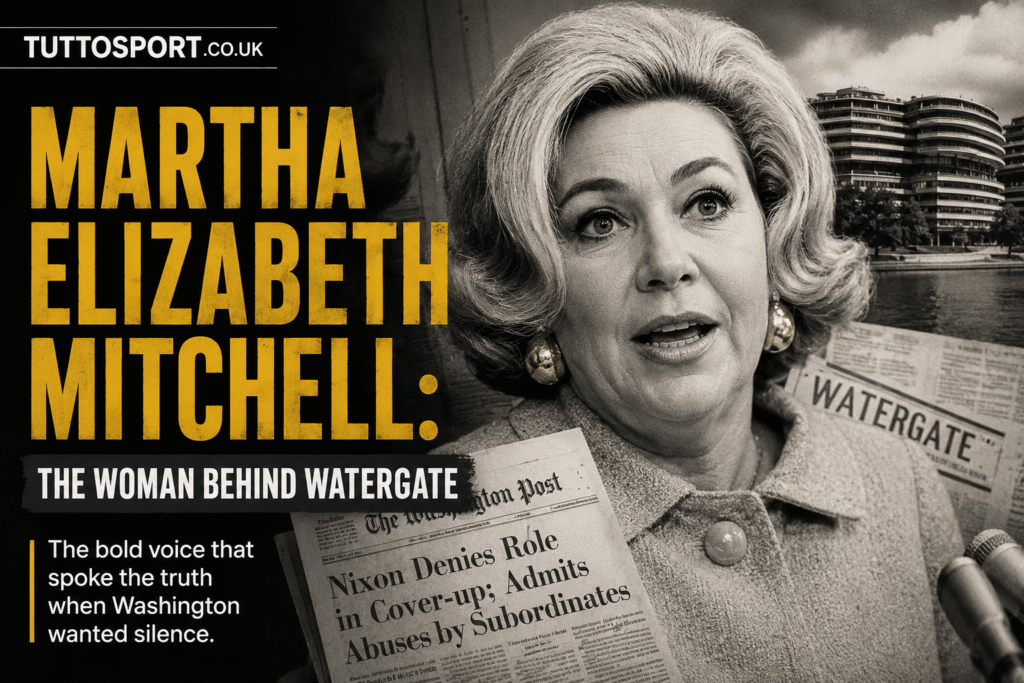
The Woman Who Refused to Stay Quiet
Some people walk into history through power. Others are pushed into it by truth.
Martha Elizabeth Mitchell belonged to the second group. She was not a president, senator, judge, or journalist. She did not hold public office. She did not run a newsroom. Yet, during one of the biggest political scandals in American history, her voice cut through the smoke before many powerful people were ready to admit there was a fire.
She was loud, stylish, sharp-tongued, emotional, funny, and impossible to ignore. In Washington, D.C., people called her a socialite. The media called her outspoken. Some critics called her unstable. But as the Watergate scandal unfolded, the world slowly discovered something uncomfortable: Martha had been closer to the truth than many wanted to believe.
The story of Martha Elizabeth Mitchell is not just about Watergate. It is about a woman who spoke when silence would have been safer. It is about reputation, politics, marriage, media pressure, and the cost of telling the truth before the world is ready to hear it.
Today, her name has returned to public conversation because her life feels strangely modern. In an age where whistleblowers, public image, media manipulation, and political spin still matter, Martha Mitchell’s story carries a powerful lesson: sometimes the person dismissed as “too much” is the one paying attention.
Martha Elizabeth Mitchell Bio
| Detail | Information |
|---|---|
| Full Name | Martha Elizabeth Beall Mitchell |
| Date of Birth | September 2, 1918 |
| Age | 57 at the time of her death |
| Profession | Socialite, public figure, political commentator, Watergate whistleblower |
| Nationality | American |
| Net Worth (Approx.) | Not reliably documented; no verified public estimate |
| Notable Works / Achievements | Known for exposing early concerns around Watergate, public interviews, and inspiring the term “Martha Mitchell effect” |
Martha Elizabeth Beall Mitchell was born in Pine Bluff, Arkansas, and later became nationally known as the wife of John N. Mitchell, who served as U.S. Attorney General under President Richard Nixon. She died on May 31, 1976, in New York City.
Who Was Martha Elizabeth Mitchell?
Martha Elizabeth Mitchell was one of the most unforgettable political personalities of the Nixon era. Long before Watergate became a symbol of corruption and cover-up, she was already famous in Washington circles for speaking her mind.
She was not the quiet political wife standing politely in the background. That was never her style. Martha enjoyed conversation, attention, and strong opinions. She called reporters. She criticized political enemies. She defended her husband when she believed he deserved defense. And when something felt wrong, she said so.
That made her fascinating to the press and dangerous to powerful insiders.
In the late 1960s and early 1970s, Washington was still shaped by strict expectations for political spouses. A woman in Martha’s position was supposed to smile, attend dinners, host guests, and avoid creating headlines. Martha did the opposite. She became a headline herself.
However, what made her story remarkable was not simply that she talked. Washington has always had talkers. What made Martha different was that some of her most shocking claims later appeared far less unbelievable than her critics insisted.
Early Life in Arkansas
Martha Elizabeth Beall was born in Pine Bluff, Arkansas. Her Southern background shaped much of her public personality. She had charm, drama, humor, and a direct way of speaking that made people listen, even when they disagreed with her.
Before she became Martha Elizabeth Mitchell, she studied at several institutions, including Stephens College, the University of Arkansas, and the University of Miami, where she earned a degree.
Her early years did not predict national scandal. Like many women of her time, she moved through life with the expectations placed on educated women in mid-century America. Yet Martha had something extra: a strong sense of self. She liked being heard. She enjoyed the room noticing her. More importantly, she trusted her instincts.
That instinct would later put her at the center of American political history.
Marriage to John N. Mitchell
Martha’s life changed dramatically when she married John N. Mitchell. He was a lawyer, political figure, and close ally of Richard Nixon. John Mitchell became U.S. Attorney General during Nixon’s administration, placing the couple in one of the most powerful circles in Washington.
At first, Martha’s bold personality worked almost like a political asset. She was entertaining. She knew how to attract attention. She was quotable, and reporters loved her because she rarely gave boring answers.
But over time, that same quality became a problem.
Political power often depends on message control. Martha did not like being controlled. She spoke freely, sometimes late at night, often to journalists, and usually with the confidence of someone who believed the public had a right to know what she thought.
For the Nixon circle, that was risky.
Martha Elizabeth Mitchell and Washington Fame
Before Watergate exploded, Martha Elizabeth Mitchell was already a celebrity in her own way. She appeared in newspapers, magazines, and television discussions. She was known for her sharp remarks, strong opinions, and glamorous presence.
People either loved her or rolled their eyes at her. But they noticed her.
In today’s language, Martha would probably be described as a media personality. She understood attention. She also understood that politics was not just policy; it was theater, loyalty, image, and influence.
However, Martha was not only performing. She had real access to conversations, people, and moods inside the Nixon world. She was married to one of the most powerful men in the administration. She saw the private side of public power.
That access made her voice important. It also made her vulnerable.
What Was Watergate?
To understand the importance of Martha Elizabeth Mitchell, we need to understand Watergate.
The Watergate scandal began with the June 17, 1972 break-in at the Democratic National Committee headquarters inside the Watergate complex in Washington, D.C. The scandal grew into a much larger investigation involving political spying, abuse of power, obstruction, and efforts to cover up wrongdoing. It eventually led to President Richard Nixon’s resignation on August 9, 1974.
For many Americans, Watergate became the moment when trust in government cracked wide open. It showed how far political operatives could go to win and how dangerous secrecy becomes when protected by power.
Martha Mitchell entered this story because she suspected something was wrong early. And unlike many people around her, she refused to stay quiet.
Martha Elizabeth Mitchell: The Woman Behind Watergate
The phrase “the woman behind Watergate” does not mean Martha planned it or controlled it. She did not. Instead, it means she became one of the first public figures connected to the Nixon inner circle to raise alarms.
Martha Elizabeth Mitchell spoke to reporters and claimed that people close to the administration were involved in serious wrongdoing. At a time when many were denying, minimizing, or hiding the truth, Martha’s comments sounded explosive.
The problem was that she was easy to dismiss.
She was emotional. She was outspoken. She sometimes sounded dramatic. And in the political world, especially at that time, a woman who spoke too loudly could be labeled unstable instead of courageous.
That is one of the most painful parts of her story. Martha was not always treated as a witness. She was treated as a problem.
The California Incident
One of the most disturbing episodes in the Martha Mitchell story happened around the time of the Watergate break-in.
Reports and later accounts describe how Martha was in California when the break-in news emerged. She allegedly tried to contact reporters after recognizing details that troubled her. According to accounts of the incident, she claimed she was held against her will, prevented from communicating, and even physically restrained.
At the time, many dismissed her claims as unbelievable. Some treated them as the ramblings of a difficult woman. But as more information about Watergate came out, her warnings gained new weight.
This moment became central to her legacy because it showed how quickly a woman’s credibility could be attacked when her words threatened powerful men.
Why People Dismissed Her
Martha Elizabeth Mitchell was dismissed for several reasons.
First, she did not fit the expected image of a political wife. She was not soft-spoken. She was not careful. She did not hide behind polished statements.
Second, she was emotionally expressive. In politics, emotion is often used against women. A man who shouts may be called passionate. A woman who shouts may be called unstable.
Third, the people around Nixon had strong reasons to discredit her. If Martha was telling the truth, then the problem was not her personality. The problem was the scandal itself.
Finally, the media loved her drama but did not always take her seriously. She was treated as colorful entertainment before she was treated as a serious source.
That combination damaged her reputation. Yet, over time, history became kinder to her than many of her contemporaries were.
The Martha Mitchell Effect
One of the most lasting parts of her legacy is the term “Martha Mitchell effect.”
The phrase is used in psychology to describe a situation where someone’s true claims are wrongly dismissed as delusional or paranoid. It connects directly to Martha’s experience during Watergate, when her claims were mocked or minimized before parts of the larger scandal became public knowledge.
This is why Martha Elizabeth Mitchell remains relevant beyond politics. Her story speaks to anyone who has told the truth and been ignored because they were inconvenient, emotional, unpopular, or difficult to categorize.
The Martha Mitchell effect is not just a historical phrase. It is a warning.
Timeline of Martha Elizabeth Mitchell’s Watergate Era
| Year | Key Event |
|---|---|
| 1918 | Martha Elizabeth Beall is born in Pine Bluff, Arkansas |
| 1969 | John N. Mitchell becomes U.S. Attorney General |
| 1972 | Watergate break-in takes place at the DNC headquarters |
| 1972 | Martha makes alarming claims connected to Watergate |
| 1974 | Richard Nixon resigns as U.S. president |
| 1976 | Martha Mitchell dies in New York City |
| Later Years | Her reputation is reexamined through books, articles, documentaries, and dramas |
This timeline shows how quickly Martha’s life moved from social fame to political tragedy.
Her Personality: Bold, Flawed, and Human
It is tempting to turn Martha Elizabeth Mitchell into a perfect heroine. But that would not be honest. She was human. She could be difficult. She enjoyed attention. She sometimes spoke in ways that made even her allies uncomfortable.
But human flaws do not cancel courage.
In fact, her imperfections make her more interesting. Martha was not a polished activist with a carefully planned public mission. She was a woman living inside a political machine who realized something was wrong and reacted in the only way she knew: loudly.
That loudness became her weapon.
Martha Elizabeth Mitchell and the Media
Martha had a complicated relationship with reporters. She needed them because they gave her a public voice. They needed her because she gave them unforgettable quotes.
But the relationship was not always fair. The press could turn Martha into a character instead of treating her as a person. She was often framed through her personality rather than her knowledge.
Even so, her calls to journalists mattered. In a world before social media, direct access to reporters was powerful. Martha understood that if she could get a journalist on the phone, she could keep herself from being completely silenced.
That instinct was ahead of its time.
Why Her Story Still Matters Today
The story of Martha Elizabeth Mitchell matters today because the themes around her life have not disappeared.
We still debate:
- Who gets believed when power is involved
- How women are judged in public life
- How media can amplify or mock a person
- How political groups protect themselves
- How truth can sound strange before evidence catches up
- How whistleblowers pay a personal price
Martha’s story reminds us that credibility is not always given to the person who deserves it. Sometimes it is given to the person who looks calmer, richer, more powerful, or more acceptable.
That is a dangerous habit.
Martha Elizabeth Mitchell in Popular Culture
In recent years, Martha’s story has returned through books, documentaries, and dramatized series about Watergate. The Starz series Gaslit, for example, brought renewed attention to her role and portrayed the personal cost she faced after speaking out.
This renewed interest is important because history often remembers the men in political scandals first. Presidents, advisers, lawyers, campaign officials, and journalists usually dominate the story. Women around them become side notes.
Martha refuses to remain a side note.
Her life asks a bigger question: how many people were right, but dismissed because they were inconvenient?
Lessons from Martha Elizabeth Mitchell’s Life
There are several strong lessons in the life of Martha Elizabeth Mitchell.
1. Truth Does Not Always Arrive Politely
Martha’s truth did not come in a calm press conference. It came through phone calls, emotional statements, and public discomfort. That made people question her. But truth does not always arrive in perfect packaging.
2. Power Often Attacks the Messenger
When someone threatens a powerful system, that system may avoid the facts and attack the person. Martha experienced this deeply.
3. Women’s Voices Have Often Been Minimized
Martha’s treatment shows how quickly outspoken women can be labeled dramatic, unstable, or unreliable. Her story still feels familiar for that reason.
4. Reputation Can Be Rewritten
During her life, Martha was mocked by many. After her death, people began to reassess her. History does not always correct itself quickly, but sometimes it does correct itself.
5. Speaking Out Has a Cost
Martha paid emotionally, socially, and personally. Her marriage suffered, her reputation was damaged, and her final years were difficult. Courage is not always rewarded in the moment.
The Personal Cost of Watergate
Behind every political scandal are private wounds. For Martha, Watergate was not just a national crisis. It was personal.
Her husband was deeply tied to Nixon’s political world. John Mitchell later served prison time for his role in the scandal. Martha, meanwhile, became increasingly isolated. Her health declined, and she died in 1976 from multiple myeloma.
That ending feels painfully unfair. She did not live long enough to see the full modern reassessment of her legacy. She did not get the kind of public apology many believe she deserved.
But the fact that people still discuss her today is its own kind of justice.
Was Martha Elizabeth Mitchell a Whistleblower?
Many people now describe Martha Elizabeth Mitchell as a Watergate whistleblower. That label fits in a broad sense because she publicly raised concerns connected to wrongdoing before the full truth became widely accepted.
However, she was not a whistleblower in the formal legal sense we often use today. She did not file protected reports through official channels. She used the tools available to her: reporters, public statements, and personal insistence.
That makes her story even more raw. She was not protected by a system. She was exposed to one.
Common Myths About Martha Elizabeth Mitchell
Myth 1: She Was Just a Political Gossip
Martha loved conversation, but reducing her to gossip ignores her proximity to real power and her early warnings about Watergate.
Myth 2: Nobody Took Her Seriously Because She Was Always Wrong
In reality, parts of her concerns gained credibility as Watergate unfolded. Her critics were often too quick to dismiss her.
Myth 3: She Wanted to Destroy Nixon from the Start
Martha was originally connected to Nixon’s world through her husband and was not simply an outside enemy. That makes her later criticism more complicated and more interesting.
Myth 4: Her Story Is Only About the Past
Her story is still relevant because public credibility, media narratives, and political pressure remain major issues today.
Martha Elizabeth Mitchell’s Legacy
The legacy of Martha Elizabeth Mitchell is layered. She is remembered as a socialite, a political wife, a media personality, and a Watergate figure. But above all, she is remembered as a woman who spoke before it was safe.
Her life also shows the danger of confusing style with substance. Because Martha was dramatic, some assumed she was wrong. Because she was emotional, some assumed she was unreliable. Because she was a woman in a male-dominated political world, some assumed she should be quiet.
History has made those assumptions look weak.
Today, Martha stands as a symbol of inconvenient truth. Her story challenges readers to ask: when someone speaks against power, do we listen to the facts, or do we judge the personality first?
Why Google Readers Search for Martha Elizabeth Mitchell
Readers search for Martha Elizabeth Mitchell because her life blends biography, politics, scandal, psychology, and mystery. She connects several high-interest topics:
- Watergate scandal
- Richard Nixon administration
- John N. Mitchell
- Political whistleblowers
- Women in American history
- Media and reputation
- Psychological gaslighting
- Government cover-ups
- 1970s American politics
- Historical scandals
This makes her story powerful for modern readers. It is not dry history. It feels alive, emotional, and surprisingly current.
Conclusion: The Voice History Could Not Silence
Martha Elizabeth Mitchell was more than “the wife of John Mitchell.” She was more than a Washington socialite. She was more than a colorful personality from the Nixon years.
She was a woman who noticed danger, spoke with force, and paid a heavy price for refusing to pretend everything was fine.
Her story is powerful because it is messy. It includes glamour, politics, fear, pride, loneliness, courage, and tragedy. That is why people continue to return to it. Martha was not perfect, but she was not silent. In the world of Watergate, that mattered.
The next time history presents someone as “too loud” or “too difficult,” Martha’s life offers a reminder: maybe the real question is not why they are speaking so loudly. Maybe the question is why so many people are trying so hard not to listen.
If this story of Martha Elizabeth Mitchell made you think differently about Watergate, political truth, or women in history, share it with someone who loves powerful real-life stories. And if you have your own thoughts on Martha’s legacy, join the conversation and keep her voice alive.